
Uttering Threats Lawyer in Toronto
Civitas Law defends people charged with uttering threats in Toronto courts, whether the words were spoken, texted, posted online or passed on by someone else. This page explains what the Crown must prove under section 264.1 of the Criminal Code, the penalties, how online threats are proved, the defences and how these charges are often resolved.
30-minute consultation, $150 plus HST, paid when you book.
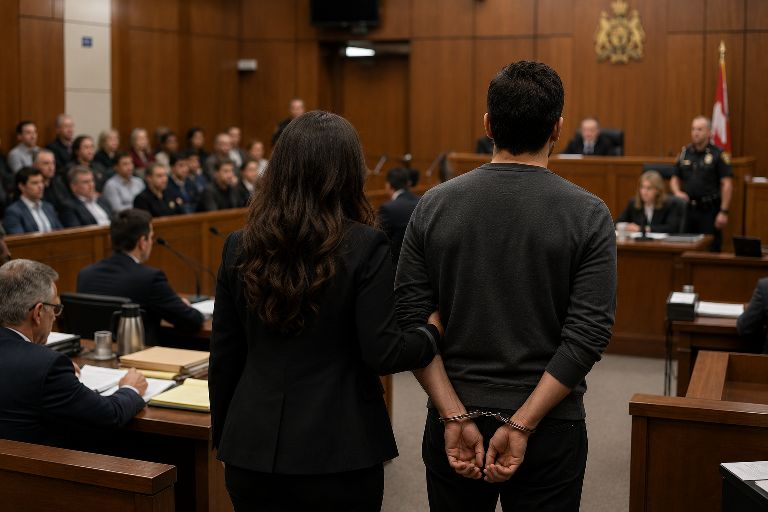
Uttering threats charges in Toronto
Short answer: Uttering threats under s. 264.1 of the Criminal Code means knowingly conveying a threat to cause death or bodily harm, to damage property, or to harm someone's animal. The Crown must prove that a reasonable person would see the words as a threat in their full context, and that you meant them to intimidate or to be taken seriously. You do not have to intend to carry the threat out. Threats of death or bodily harm carry up to five years by indictment, and many first-time cases resolve without a criminal record.
Civitas Law is a team of legal professionals under the leadership of lawyer Nasibeh Mehrpouyan, with an office at 4789 Yonge Street, Suite 402, Toronto, at Yonge and Sheppard in North York. We work in English, French, Farsi, Russian and Serbian. Our team defends uttering threats charges in Toronto and across the GTA, whether laid alone or together with assault, harassment or mischief. Where the threat is alleged against a spouse or partner, see also our domestic assault page, because the case will follow the intimate partner process. If someone has been arrested and held, see our bail hearings page.
What the Crown must prove under section 264.1
s. 264.1 makes it an offence to knowingly utter, convey or cause any person to receive a threat:
- to cause death or bodily harm to any person;
- to burn, destroy or damage real or personal property; or
- to kill, poison or injure an animal or bird that belongs to any person.
The Supreme Court of Canada has set out the test in R. v. McCraw (1991), R. v. Clemente (1994) and R. v. McRae (2013). There are two parts.
The words. The question is whether a reasonable person, aware of all the circumstances, would understand the words as a threat of death, bodily harm or damage. The court looks at the words themselves, the tone, the setting, the history between the people, and how the listener reacted. Words are not read in isolation.
Your intent. The Crown must also prove that you meant the words to intimidate or to be taken seriously. Words said as an obvious joke, as hyperbole, or as an expression of frustration that no one was meant to believe can fall short of this.
What the Crown does not have to prove:
- that you intended to carry the threat out, or were able to;
- that the person threatened was actually afraid;
- that the person threatened heard or received the threat, as long as it was conveyed to someone;
- that the threat was made in person. The section says in any manner.
Penalties for uttering threats in Ontario
Uttering threats is a hybrid offence, so the Crown chooses whether to proceed by indictment or summarily.
- Threats of death or bodily harm (s. 264.1(1)(a)): up to five years by indictment. On summary conviction, the general maximum is two years less a day and a $5,000 fine (s. 787).
- Threats to property or animals (s. 264.1(1)(b) and (c)): up to two years by indictment, or summary conviction.
- Threats against an intimate partner: since 2026, the Crown can charge an offence involving threatened violence against a spouse or partner under s. 263.1, which raises the maximum for a death or bodily harm threat to 10 years.
There is no mandatory minimum, so a discharge under s. 730 is available, and many first-time cases end with probation or a discharge rather than jail. Sentencing considers the seriousness of the words, any weapon involved, the effect on the person threatened, whether the threat targeted a partner, a child, a justice participant or a group, and your record. A court can also make a weapons prohibition order (s. 110).
Threats by text, email and social media
Because s. 264.1 covers threats conveyed in any manner, a large share of Toronto threats cases now involve messages rather than spoken words: texts, WhatsApp or Telegram messages, comments on Instagram or TikTok, emails, voicemails and posts in group chats.
- The whole conversation matters. Police disclosure often contains screenshots of a few messages. The messages before and after, including the other person's, can change how a reasonable person would read them.
- Who sent it. The Crown must prove that you wrote and sent the message. A message from an account, phone or email linked to you is evidence, but shared devices, hacked accounts and impersonation are real issues in some cases.
- Authenticity. Electronic documents must meet the rules in the Canada Evidence Act, and edited or partial screenshots can be challenged.
- Public posts. A post does not need to be sent to the person it is about. A threat posted where the target or others will see it can be charged.
- Translation. For messages in Farsi, Russian, Serbian or French, a literal translation can make ordinary idioms sound violent. Our team reviews the original language with the translation in the disclosure.
Repeated messages that make someone fear for their safety may instead, or also, be charged as criminal harassment under s. 264.
Threats at home, at work, at school and to police
- Family and relationships. Threats between partners are handled in the Domestic Violence Court program, usually with no-contact release conditions and the same resolution options as a domestic assault case.
- Workplaces. Words said to a manager or co-worker can lead to a charge as well as discipline or dismissal. Your employment rights are a separate matter for an employment lawyer.
- Schools and young people. Students aged 12 to 17 are dealt with under the Youth Criminal Justice Act. See youth criminal defence.
- Police officers. Threats made during an arrest are often added to other charges. Context, intoxication and whether the words were meant seriously are examined as in any other case.
- Neighbours and strangers. Disputes over parking, noise or property lines can escalate into a threats charge, and they are often resolved by a peace bond.
How uttering threats charges are resolved
Every case depends on its evidence, and no result can be promised. The realistic options include:
- Withdrawal where the words, the context or the identity of the sender cannot be proved.
- A peace bond under s. 810, where the charge is withdrawn and you agree to conditions such as no contact for up to 12 months. This is a common resolution for first-time threats charges without violence.
- Diversion, where the Crown agrees to withdraw the charge after you complete steps such as counselling or a community program, in cases the Crown considers suitable.
- A discharge, which is a finding of guilt without a conviction.
- A trial, where the Crown must prove both parts of the test beyond a reasonable doubt.
What does an uttering threats lawyer cost in Toronto?
Criminal defence fees depend on the charge, the volume of disclosure, whether there is a bail hearing, how many court appearances are needed and whether the case goes to trial. Too few Toronto firms publish a fee for this type of charge to give a reliable market figure, so we do not show one. For context, the ranges Ontario firms do publish for other charges are below.
| Service | Typical fee | Range published |
|---|---|---|
| Impaired driving or over 80, first offence, resolved without trial | $5,900 | $3,500 to $15,000 |
| Simple assault, mischief or theft under $5,000 | $5,750 | $1,500 to $15,000 |
| Hourly rate, criminal defence | about $410 an hour | $75 to $800 an hour |
How we measured this: we reviewed fee ranges that Ontario criminal defence firms publish on their own websites, checked in November 2026. These are typical market ranges, not Civitas Law's fees, and they usually exclude HST and disbursements. Only a few firms publish criminal fees, so a figure is shown only where at least three firms published one. Civitas Law explains its fee in writing before you retain us. The 30-minute consultation is $150 plus HST, paid when you book.
Defences our team looks at in a threats case
- Context and meaning. Whether a reasonable person who knew the whole situation would see the words as a threat, or as a joke, an exaggeration or venting.
- Intent. Whether the evidence shows you meant to intimidate or be taken seriously. Intoxication, anger and mental health can be relevant to this question.
- Conditional or vague words. Statements such as "you will regret this" may not threaten death, bodily harm or damage at all.
- Identity and authenticity in message-based cases.
- Credibility. Where the only evidence is one person's account of spoken words, inconsistencies with their earlier statements, their motive and the surrounding facts are tested in cross-examination.
- Charter issues, such as the search of a phone without a valid warrant or a statement taken without access to a lawyer.
Release conditions, records and immigration
Release. Most people charged with uttering threats are released by police with conditions not to contact the complainant or go near certain places, and often not to possess weapons. Breaching those conditions is a separate offence, so follow them exactly. If they are unworkable, a bail variation may help.
Your record. A conviction creates a criminal record until a record suspension is granted. A discharge is not a conviction and is removed from the national police database after one or three years. A peace bond is not a conviction.
Immigration. Uttering threats is a hybrid offence, which counts as indictable for immigration purposes. A conviction can make a foreign national inadmissible for criminality under s. 36 of the Immigration and Refugee Protection Act. For a permanent resident, a sentence of more than six months, or a charge under s. 263.1 with its 10-year maximum, can reach serious criminality. See immigration consequences of criminal charges. To discuss your case, Book a consultation (30 minutes, $150 plus HST, paid when you book) or call (647) 271-1646.
Questions we hear often
General information, not legal advice. Every matter is different.
What is uttering threats in Canada?
Is uttering threats a criminal offence in Ontario?
What is the sentence for uttering threats in Ontario?
Will I go to jail for uttering threats as a first offence?
Can uttering threats charges be dropped?
Is uttering threats a summary or indictable offence?
Can I be charged for a threat made by text or on social media?
Can you be charged if the person never heard the threat?
What if I was joking or just angry?
What evidence is needed to prove uttering threats?
What is the difference between uttering threats and criminal harassment?
Is threatening to damage property or hurt a pet a crime?
Can a peace bond resolve an uttering threats charge?
Does an uttering threats charge give me a criminal record?
Can I contact the person after being charged with uttering threats?
What is an uttering death threats charge?
Can uttering threats affect my immigration status?
How long does an uttering threats case take in Toronto?
Is it uttering threats if I threatened a police officer?
Related services and guides
Criminal defence
All criminal charges in Toronto courts.
Assault charges
Assault, assault with a weapon and bodily harm.
Domestic assault
Intimate partner charges and no-contact conditions.
Criminal harassment
Repeated contact, following and monitoring.
Peace bonds
Section 810 peace bonds and how they resolve charges.
Bail hearings
Release conditions after an arrest.
Talk to our team
Book a consultation online or call (647) 271-1646 (the phone is answered 24/7). 30-minute consultation, $150 plus HST, paid when you book. Legal fees after that depend on the work involved, and we explain them in writing before you retain us.
Straightforward legal advice from a Toronto lawyer.
30-minute consultation, $150 plus HST, paid when you book. Personal injury matters start with a free 10-minute case review with the lawyer. Consultations are confidential.