
Peace Bond Lawyer in Toronto
Civitas Law acts on peace bonds in Toronto, whether you are asking the court for one, responding to an application against you, or considering a peace bond to resolve a criminal charge. This page explains section 810 and the other peace bond sections of the Criminal Code, the process at the courthouse, conditions, breach and what a peace bond means for your record.
30-minute consultation, $150 plus HST, paid when you book.
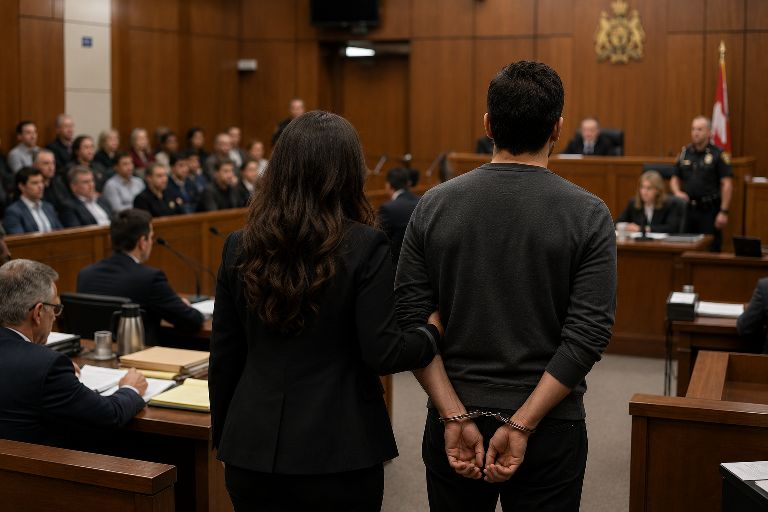
Peace bonds in Ontario: what they are and when they are used
Short answer: A peace bond is a criminal court order under s. 810 of the Criminal Code that requires a person to keep the peace and be of good behaviour, usually with conditions such as no contact and staying away from certain places, for up to 12 months. It is not a conviction and does not create a criminal record, but breaching it is a criminal offence. Peace bonds arise in two ways: a person who fears harm applies for one, or the Crown withdraws a criminal charge in exchange for one.
Civitas Law is a team of legal professionals under the leadership of lawyer Nasibeh Mehrpouyan, with an office at 4789 Yonge Street, Suite 402, Toronto, at Yonge and Sheppard in North York. We work in English, French, Farsi, Russian and Serbian. Our team acts for people responding to peace bond applications, for people charged with offences where a peace bond may resolve the case, and for people who need to apply for one. Peace bonds most often come up in domestic assault, uttering threats, criminal harassment and neighbour or workplace disputes.
What is a section 810 peace bond?
Under s. 810, anyone who fears on reasonable grounds that another person will injure them, their intimate partner or their child, or damage their property, or share an intimate image of them without consent, can lay an information before a justice. If the court is satisfied that the fear is based on reasonable grounds, it can order the defendant to enter into a recognizance to keep the peace and be of good behaviour for not more than 12 months.
Key points about a s. 810 peace bond:
- It can be made against anyone, including a neighbour, co-worker, former friend or relative. No relationship is required.
- The person seeking it does not have to prove a crime was committed, only a reasonable fear.
- It is made in criminal court by a justice of the peace or a judge of the Ontario Court of Justice.
- It is not a conviction. The defendant is not found guilty of anything.
- A defendant who refuses to sign a peace bond the court has ordered can be jailed for up to 12 months (s. 810(3.01)).
Ontario explains the application process on its getting a peace bond page.
Other kinds of peace bond in the Criminal Code
Several other sections allow a peace bond for specific fears. They usually need stronger evidence or the Attorney General's consent, and some can last longer.
- Fear of domestic violence (s. 810.03): where someone fears a person will injure their intimate partner or child. Up to 12 months, or up to two years if the defendant has a prior conviction for intimate partner violence. Conditions can include a domestic violence counselling program, staying within an area and, with the Attorney General's consent, electronic monitoring.
- Sexual offences against children (s. 810.1): where someone fears a sexual offence against a person under 18. Up to 12 months, or two years with a prior conviction for a sexual offence against a child. Conditions can restrict contact with children and internet use.
- Serious personal injury offences (s. 810.2): needs the Attorney General's consent. Up to 12 months, or two years with a prior conviction for such an offence. These are often sought when someone is released from a penitentiary sentence.
- Criminal organization offences (s. 810.01): needs the Attorney General's consent and is heard by a provincial court judge.
- Common law peace bonds: judges also have a long-standing power to order a person before the court to keep the peace. These are less common in Toronto than s. 810 bonds.
What conditions can a peace bond include?
The court can add any reasonable conditions it considers desirable to secure the defendant's good conduct. Common conditions are:
- no contact or communication, directly or indirectly, with the named person and their family;
- not to attend, or come within a set distance of, their home, workplace or school;
- not to possess weapons. Before making a s. 810 order, the court must consider a weapons prohibition and must give reasons if it does not impose one (s. 810(3.1) and (3.12));
- to abstain from alcohol or drugs, with testing on demand in some cases;
- to keep the peace and be of good behaviour, which is always included.
Conditions are drafted for the situation. In a dispute between neighbours, they may allow passing in the hallway or using the shared driveway. Either party can later ask the court to vary the conditions (s. 810(4.1)).
How to apply for a peace bond in Toronto
You do not need a lawyer to apply, although one can help you prepare. The steps, as set out by Ontario, are:
- Go to the criminal service counter of a provincial courthouse. In Toronto this is normally the Toronto Courthouse at 10 Armoury Street. Staff will give you the application form.
- Complete the application with the details of why you fear the person and their address. A justice reviews it and decides whether there are grounds to proceed.
- Swear the information. If the application goes ahead, court staff prepare an information for you to sign under oath. The justice then issues a summons to the defendant or, where there is danger or a risk they will not attend, a warrant for their arrest.
- Attend the first appearance. The defendant decides whether to consent. If you do not attend, the application ends.
- The hearing. If the defendant does not consent, a hearing is set where both sides give evidence under oath and can call witnesses and cross-examine.
Evidence that helps includes texts, emails, voicemails and social media messages, photographs of damage, police occurrence numbers, and witnesses who saw or heard the conduct. Dates matter, so keep a written log. If you are in immediate danger, call 911.
If someone has applied for a peace bond against you
Being served with a summons for a peace bond hearing is stressful, but it is not a criminal charge. You have three main options:
- Consent to the peace bond, often after negotiating the conditions so they are workable for your home, job and family.
- Propose a mutual peace bond, where both people agree to the same conditions, such as no contact with each other. This is common in disputes where both sides have complaints.
- Contest the application at a hearing, where the applicant must show the court that their fear is reasonable. You can give evidence, call witnesses and cross-examine the applicant.
Before you decide, think about immigration status, travel, employment that needs a police check, and any family court case. A peace bond is not a conviction, but its conditions can affect where you can go and who you can speak to for a full year. If you hold a firearms licence, a weapons condition may require you to surrender firearms and your licence.
Signing a peace bond to resolve a criminal charge
Many assault, threats, harassment and mischief charges in Toronto end with a peace bond. The Crown withdraws the criminal charge and the accused enters into a s. 810 recognizance, usually for 12 months, with conditions such as no contact with the complainant.
- No finding of guilt. You do not plead guilty, and the charge is withdrawn. The court usually only needs to accept that the complainant has a reasonable fear, and you are typically not asked to admit the facts alleged.
- Why the Crown agrees. Peace bonds are used where the Crown is satisfied that court-ordered conditions will protect the complainant, often in first-time cases with no serious injury.
- Why accused people agree. It ends the case without a trial or a criminal record. The trade-off is a year of conditions and the risk of a breach charge.
- When it may not be the right choice. If the evidence is weak, a trial may lead to an acquittal with no conditions at all. Our team discusses that choice with you after reviewing disclosure.
For people who are not Canadian citizens, a peace bond is not a conviction under s. 36 of the Immigration and Refugee Protection Act, which is one reason it is often preferred over a guilty plea. See immigration consequences of criminal charges.
What does a peace bond lawyer cost in Toronto?
Criminal defence fees depend on the charge, the volume of disclosure, whether there is a bail hearing, how many court appearances are needed and whether the case goes to trial. Too few Toronto firms publish a fee for this type of charge to give a reliable market figure, so we do not show one. For context, the ranges Ontario firms do publish for other charges are below.
| Service | Typical fee | Range published |
|---|---|---|
| Impaired driving or over 80, first offence, resolved without trial | $5,900 | $3,500 to $15,000 |
| Simple assault, mischief or theft under $5,000 | $5,750 | $1,500 to $15,000 |
| Hourly rate, criminal defence | about $410 an hour | $75 to $800 an hour |
How we measured this: we reviewed fee ranges that Ontario criminal defence firms publish on their own websites, checked in November 2026. These are typical market ranges, not Civitas Law's fees, and they usually exclude HST and disbursements. Only a few firms publish criminal fees, so a figure is shown only where at least three firms published one. Civitas Law explains its fee in writing before you retain us. The 30-minute consultation is $150 plus HST, paid when you book.
What happens if a peace bond is breached?
Breaching a peace bond is a criminal offence under s. 811, with a maximum of four years by indictment, or it can be prosecuted summarily. Police enforce peace bonds across Canada and can arrest for a breach. A breach conviction creates a criminal record even though the peace bond itself did not.
Breach can also affect bail. If someone is charged with violence against an intimate partner while bound by a peace bond made for an intimate partner, they face a reverse onus at the bail hearing (s. 515(6)(b.1)). See our bail hearings and breach of probation pages.
If a peace bond is about to expire and the person who sought it still has reasonable grounds to fear, they can apply for a new one. They do not have to wait for the first one to end.
Peace bond, restraining order or bail conditions?
- Peace bond: made in criminal court under s. 810, against anyone, for up to 12 months in most cases. Breach is an offence under s. 811.
- Restraining order: made in family court under Ontario family law. It is available only against a spouse or former spouse, someone you lived with, or the other parent of your child, and it can last longer. Ontario explains this on its restraining order page. Our family law team can help with that process.
- Bail or release conditions: imposed on a person charged with an offence while the criminal case is ongoing. They end when the case ends, which is sometimes when a peace bond takes their place.
To talk about which applies to you, Book a consultation (30 minutes, $150 plus HST, paid when you book) or call (647) 271-1646.
Questions we hear often
General information, not legal advice. Every matter is different.
How long does a peace bond last in Ontario?
Do you need a lawyer for a peace bond hearing?
Is it hard to get a peace bond in Ontario?
Does it cost to get a peace bond?
What evidence do you need for a peace bond?
Is a peace bond worth it?
Can I apply for a peace bond online in Ontario?
What qualifies for a restraining order in Ontario?
Is a peace bond a criminal record?
Does signing a peace bond mean I admit guilt?
Can I refuse to sign a peace bond?
What is a mutual peace bond?
What happens if I breach a peace bond?
Can a peace bond be changed or ended early?
Will a peace bond affect my immigration status?
Can I travel to the United States with a peace bond?
Can a peace bond stop me from owning firearms?
Can I get a peace bond against a neighbour or co-worker?
What is a domestic violence peace bond?
What is an 810.1 or 810.2 peace bond?
How long does it take to get a peace bond in Toronto?
Can a peace bond be renewed?
Related services and guides
Criminal defence
All criminal charges in Toronto courts.
Domestic assault
Intimate partner charges and no-contact conditions.
Uttering threats
Threats in person, by text or online.
Criminal harassment
Repeated contact, following and monitoring.
Bail hearings
Release conditions after an arrest.
Family law
Restraining orders and parenting matters.
Talk to our team
Book a consultation online or call (647) 271-1646 (the phone is answered 24/7). 30-minute consultation, $150 plus HST, paid when you book. Legal fees after that depend on the work involved, and we explain them in writing before you retain us.
Straightforward legal advice from a Toronto lawyer.
30-minute consultation, $150 plus HST, paid when you book. Personal injury matters start with a free 10-minute case review with the lawyer. Consultations are confidential.