
Weapons and Firearms Charges Lawyer in Toronto
Civitas Law defends people charged with weapons and firearms offences in Toronto courts, from carrying a concealed knife to possession of a loaded handgun. This page explains what counts as a weapon or firearm, the main offences in sections 85 to 117 of the Criminal Code, mandatory minimum sentences, reverse-onus bail and how these charges are defended.
30-minute consultation, $150 plus HST, paid when you book.
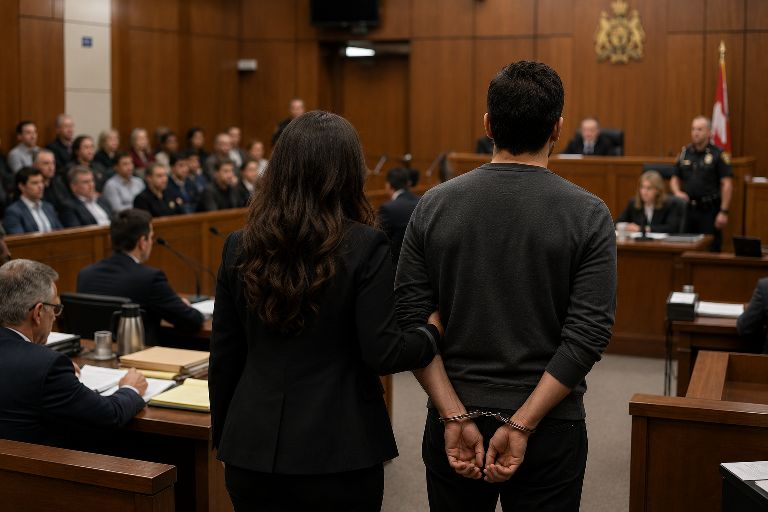
Weapons and gun charges in Toronto courts
Short answer: Weapons and firearms offences are set out mainly in sections 85 to 117 of the Criminal Code. They range from careless storage by a licensed owner to possession of a loaded prohibited or restricted firearm (s. 95), which carries up to 14 years. Many gun charges bring a reverse onus at bail, and a few still carry mandatory minimum sentences. Most cases turn on whether police searched lawfully and whether the Crown can prove you knew about the weapon and controlled it.
Civitas Law is a team of legal professionals under the leadership of lawyer Nasibeh Mehrpouyan, with an office at 4789 Yonge Street, Suite 402, Toronto, at Yonge and Sheppard in North York. We work in English, French, Farsi, Russian and Serbian. Our team defends weapons and firearms charges in Toronto and across the GTA, including cases laid alongside drug, robbery or assault charges. If someone is in custody, start with our bail hearings page, because gun charges are among the hardest bail cases in Ontario.
Assault with a weapon under s. 267 is covered on our assault lawyer page, and robbery with a firearm on our robbery lawyer page. This page deals with the possession, carrying, use and licensing offences themselves.
What counts as a weapon or a firearm under the Criminal Code?
The definitions in s. 2 and s. 84 decide which offence applies, and they are often where a defence begins.
- Weapon means anything used, designed to be used or intended for use to cause death or injury, or to threaten or intimidate a person, and it includes a firearm. A kitchen knife, a bat or a bottle can become a weapon by how it is carried or used.
- Firearm means a barrelled weapon that can discharge a shot, bullet or other projectile and is capable of causing serious bodily injury or death, including its frame or receiver. Some air guns meet this definition and others do not, which can require testing of the muzzle velocity.
- Firearm classes. Firearms are non-restricted, restricted or prohibited. Most handguns are restricted or prohibited, and the class decides which licence and registration certificate the owner needs.
- Prohibited weapon includes a knife whose blade opens automatically by gravity, centrifugal force or a button or spring in the handle, and any weapon named in the federal regulations, such as certain sprays designed for use on people.
- Imitation firearm means anything that looks exactly or almost exactly like a firearm. Using one during an indictable offence is a separate crime.
Common weapons and firearms offences in Ontario
Maximum sentences below are for the indictable route. Most of these offences are hybrid, so the Crown can also proceed summarily, where the general maximum is two years less a day.
- Careless use or storage of a firearm or ammunition (s. 86): up to two years for a first offence and five for a later one.
- Pointing a firearm at another person, loaded or not (s. 87): up to five years.
- Possession of a weapon for a dangerous purpose (s. 88): up to 10 years. This is the usual charge for carrying a knife or bat to a confrontation.
- Carrying a concealed weapon (s. 90): up to five years, unless the Firearms Act authorizes concealed carry.
- Unauthorized possession of a firearm without a licence or registration certificate (s. 91): up to five years. Knowing unauthorized possession (s. 92) is indictable only, with up to 10 years.
- Being in a motor vehicle you know contains a firearm, prohibited weapon or prohibited device, unless someone in the vehicle is authorized to have it (s. 94): up to 10 years. The section does not apply to an occupant who left, or tried to leave, once they became aware of it.
- Possession of a loaded prohibited or restricted firearm, or one with readily accessible ammunition (s. 95): up to 14 years.
- Possession of a weapon obtained by crime (s. 96): up to 14 years.
- Using a firearm or imitation firearm while committing an indictable offence (s. 85): up to 14 years, served consecutively to any other sentence.
- Trafficking, possession for trafficking and importing (s. 99, s. 100, s. 103): up to 14 years.
- Possessing a weapon while prohibited by a court order (s. 117.01): up to 10 years.
Mandatory minimum sentences after Nur and Hills
Mandatory minimums for gun crimes have changed several times, and older articles online are often out of date.
- In R. v. Nur (2015), the Supreme Court of Canada struck down the three-year minimum for possession of a loaded prohibited or restricted firearm under s. 95. Today s. 95 has no minimum.
- In R. v. Hills (2023), the Court struck down the minimum for reckless discharge of a firearm into or at a place.
- In 2022 Parliament repealed several firearm minimums. As of November 2026, the Criminal Code sets no minimum for s. 85, s. 92 or s. 95.
- Minimums remain for some of the most serious offences: three years for a first offence of trafficking, possession for trafficking or importing where a firearm is involved (ss. 99, 100 and 103), and longer minimums where a restricted or prohibited firearm is used in robbery, extortion or intentional discharge.
- In 2026 Parliament added s. 718.4. A judge must now impose a shorter term than a mandatory minimum where the minimum would be cruel and unusual punishment for that offender, unless the minimum is life imprisonment.
Without a minimum, sentencing depends on the type of weapon, whether it was loaded, where it was found, the person's role and record, and the purposes of denunciation and deterrence. Ontario courts treat loaded handguns in public places very seriously, and penitentiary sentences are common for adults in those cases. A licensed owner's regulatory breach is at the other end of the range, where a discharge may be available.
Bail for gun charges: the reverse onus
For most charges, the Crown must show why someone should be detained. Under s. 515(6), the accused must instead show why release is justified when charged with:
- possession of a loaded prohibited or restricted firearm (s. 95), firearms trafficking or importing (ss. 99, 100, 103), making an automatic firearm (s. 102) or breaking and entering or robbery to steal a firearm (ss. 98, 98.1);
- robbery, extortion, kidnapping, attempted murder or certain sexual offences allegedly committed with a firearm, or discharging a firearm (ss. 244, 244.2);
- any offence involving a firearm or other weapon while already under a weapons prohibition order;
- some offences of violence with a weapon, where the accused was convicted of a similar violent weapons offence within the past 10 years.
A reverse onus does not mean detention is automatic. It means arriving with a strong release plan: a suitable residence, sureties who can supervise, and conditions that answer the court's concerns. The court also considers whether a firearm was used and any minimum sentence of three years or more when deciding whether detention is needed to maintain confidence in the justice system. Our show cause hearing guide and sureties page explain the process.
Licensed owners: storage, transport and prohibition orders
Many firearms charges involve people who hold a valid licence. Storage, display and transport rules come from regulations under the Firearms Act, and breaking them can lead to a charge under s. 86. An expired licence can turn otherwise lawful possession into an offence under s. 91. A charge for any offence of violence also usually leads to the Chief Firearms Officer reviewing the licence.
On a finding of guilt, a weapons prohibition order may follow:
- Mandatory under s. 109 for serious violent offences, offences of violence against an intimate partner prosecuted by indictment, and listed firearms offences such as ss. 85, 95, 99 and 100. A first order lasts at least 10 years for ordinary firearms and for life for prohibited and restricted ones.
- Discretionary under s. 110 for other offences involving violence or weapons, for up to 10 years, or for life where the violence was against an intimate partner or family member.
Any person can also apply to a provincial court judge for an emergency weapons prohibition order (s. 110.1) or an order limiting a household member's access to weapons (s. 117.0101). Our team can respond to these applications as well.
How weapons and gun charges are defended
- The search. Many gun cases begin with a traffic stop, a search of a car, a home search under a warrant or a pat-down on the street. If police breached section 8, 9 or 10 of the Canadian Charter of Rights and Freedoms, the defence can ask the court to exclude the weapon under s. 24(2). Warrant applications and their supporting information are reviewed line by line.
- Possession. The Crown must prove knowledge and control. A gun found in a shared car, a bedroom used by several people or a bag that belongs to someone else raises the question of who actually possessed it. Constructive and joint possession under s. 4(3) each have specific requirements.
- Is it a firearm or weapon? Whether an item fits the definitions, whether it works, and whether a knife or spray is prohibited are questions of evidence, often answered by forensic testing.
- Lawful excuse and licensing. Many sections allow a lawful excuse, and a licence or registration certificate may be a full answer to a possession charge.
- Self-defence. Using or pointing a weapon to defend yourself or someone else is judged under s. 34. Carrying a weapon in advance for protection is treated differently, and a court will ask whether the response was reasonable.
- Identity and forensic evidence. DNA, fingerprints, video and phone evidence are tested for how they were collected and what they actually show.
What does a firearms and weapons charges lawyer cost in Toronto?
Criminal defence fees depend on the charge, the volume of disclosure, whether there is a bail hearing, how many court appearances are needed and whether the case goes to trial. Too few Toronto firms publish a fee for this type of charge to give a reliable market figure, so we do not show one. For context, the ranges Ontario firms do publish for other charges are below.
| Service | Typical fee | Range published |
|---|---|---|
| Impaired driving or over 80, first offence, resolved without trial | $5,900 | $3,500 to $15,000 |
| Simple assault, mischief or theft under $5,000 | $5,750 | $1,500 to $15,000 |
| Hourly rate, criminal defence | about $410 an hour | $75 to $800 an hour |
How we measured this: we reviewed fee ranges that Ontario criminal defence firms publish on their own websites, checked in November 2026. These are typical market ranges, not Civitas Law's fees, and they usually exclude HST and disbursements. Only a few firms publish criminal fees, so a figure is shown only where at least three firms published one. Civitas Law explains its fee in writing before you retain us. The 30-minute consultation is $150 plus HST, paid when you book.
Youth, immigration and other consequences
Young people. Youths aged 12 to 17 charged with weapons offences are dealt with under the Youth Criminal Justice Act, with different sentencing rules and record access periods. See our youth criminal defence page.
Immigration. Section 95 and most other firearms offences carry maximums of 10 years or more. For a permanent resident, a conviction can mean inadmissibility for serious criminality under s. 36 of the Immigration and Refugee Protection Act, which can lead to removal without an appeal to the Immigration Appeal Division where the sentence is six months or more. Tell us your status at the first meeting, and see immigration consequences of criminal charges.
Related charges. Weapons charges are often laid with drug trafficking, organized crime and conspiracy counts. See our drug charges and conspiracy and organized crime pages. To discuss your case, Book a consultation (30 minutes, $150 plus HST, paid when you book) or call (647) 271-1646.
Questions we hear often
General information, not legal advice. Every matter is different.
What is the sentence for possession of a loaded handgun in Ontario?
Is there still a mandatory minimum sentence for gun charges in Canada?
Can gun charges be dropped in Ontario?
What should I do after being charged with a firearm offence in Toronto?
Can I get bail on a gun charge?
What is a concealed weapon charge in Canada?
Is it illegal to carry a knife in Ontario?
What is possession of a weapon for a dangerous purpose?
Is pepper spray legal in Canada?
Is a pellet or BB gun a firearm in Canada?
What if the gun was in a car I was in but was not mine?
Can you defend yourself with a gun in Canada?
What happens to my firearms licence if I am charged?
How long does a weapons prohibition order last?
What is careless storage of a firearm?
What is the difference between ss. 91 and 92?
Can a youth be charged with a firearm offence?
Can a permanent resident be deported for a gun charge?
Can I be charged for using a fake or imitation gun?
Related services and guides
Criminal defence
All criminal charges in Toronto courts.
Bail hearings
Release after an arrest, including reverse onus.
Robbery and kidnapping
Robbery with a firearm and related charges.
Assault charges
Assault with a weapon and bodily harm.
Youth criminal defence
Young persons charged under the YCJA.
Organized crime
Conspiracy and criminal organization charges.
Talk to our team
Book a consultation online or call (647) 271-1646 (the phone is answered 24/7). 30-minute consultation, $150 plus HST, paid when you book. Legal fees after that depend on the work involved, and we explain them in writing before you retain us.
Straightforward legal advice from a Toronto lawyer.
30-minute consultation, $150 plus HST, paid when you book. Personal injury matters start with a free 10-minute case review with the lawyer. Consultations are confidential.