
Criminal Appeal Lawyer in Toronto
A criminal appeal asks a higher court to review a conviction, an acquittal or a sentence for legal error. In Ontario, summary conviction cases are appealed to the Superior Court of Justice and indictable cases to the Court of Appeal for Ontario, usually within 30 days. This page explains appeal routes, deadlines, grounds, bail pending appeal and what the appeal court can do.
30-minute consultation, $150 plus HST, paid when you book.
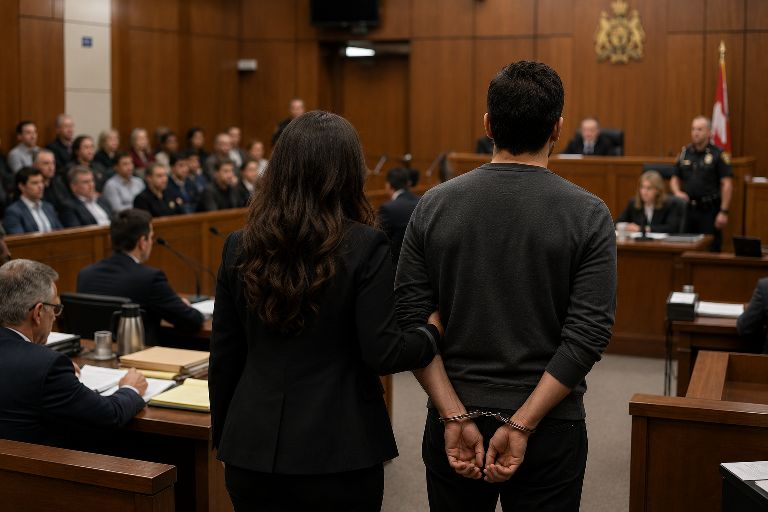
Criminal appeals in Ontario
Short answer: A criminal appeal is not a new trial. The appeal court reviews the record of the trial for errors of law, unreasonable verdicts, miscarriages of justice or an unfit sentence. In Ontario, indictable cases go to the Court of Appeal for Ontario and summary conviction cases go to the Superior Court of Justice. In both courts the notice of appeal is generally due within 30 days after sentence, and a person in custody can apply for bail pending appeal.
Civitas Law is a team of legal professionals under the leadership of lawyer Nasibeh Mehrpouyan, practising criminal law in Toronto in English, French, Farsi, Russian and Serbian. Civitas Law handles criminal appeals, including summary conviction appeals in the Superior Court of Justice, appeals to the Court of Appeal for Ontario and applications for bail pending appeal. This page explains how criminal appeals work in Ontario as of November 2026: which court hears the appeal, the deadlines, the grounds the courts accept, release pending appeal and the possible results. It is general information. Appeal deadlines are short, so if you have just been convicted or sentenced, get advice right away.
Appeals are the last stage of the criminal process described on our Toronto criminal defence page. The rights of appeal are in Part XXI (indictable offences) and Part XXVII (summary conviction offences) of the Criminal Code.
Summary conviction appeals and indictable appeals
The route depends on how the Crown proceeded at trial, not on how serious the charge sounds.
- Summary conviction appeals. Where the Crown proceeded summarily in the Ontario Court of Justice, the appeal goes to the Superior Court of Justice under s. 813 of the Criminal Code. In Toronto, summary conviction appeals are heard at 361 University Avenue. A further appeal to the Court of Appeal for Ontario is possible only on a question of law and only with leave, under s. 839.
- Indictable appeals. Where the Crown proceeded by indictment, whether the trial was in the Ontario Court of Justice or the Superior Court of Justice, the appeal goes to the Court of Appeal for Ontario under s. 675. The court sits at Osgoode Hall, 130 Queen Street West, Toronto.
- Supreme Court of Canada. From the Court of Appeal, a further appeal lies to the Supreme Court of Canada as of right where a judge of the Court of Appeal dissented on a question of law, and otherwise only with leave.
How long do you have to appeal a criminal conviction in Ontario?
Under Rule 8(3) of the Court of Appeal for Ontario Criminal Appeal Rules, a person appealing a conviction or sentence in an indictable case must file the notice of appeal within 30 days after the day the sentence is imposed. Where the Crown appeals an acquittal or a sentence, it must serve its notice within 30 days and file it within five days after that. Summary conviction appeals to the Superior Court of Justice also run on a 30-day period from sentence under that court's criminal rules.
- Missed the deadline? The court can extend the time. If the Crown consents, a judge or the Registrar can grant up to 30 more days; otherwise you bring a motion. Judges look at whether you formed an intention to appeal within the time, how the delay is explained, and whether the appeal has merit.
- Inmate appeals. A person in custody without a lawyer can start an inmate appeal by giving the notice to the senior official at the institution, which counts as filing.
- Supreme Court of Canada. An application for leave to appeal to the Supreme Court is generally due within 60 days of the Court of Appeal's judgment.
Rule numbers and forms can change, so the current rules on the Court of Appeal's website govern.
Grounds of appeal: what an appeal court can review
For an appeal from conviction, s. 686(1)(a) of the Criminal Code allows the court to set aside the conviction on three grounds:
- Unreasonable verdict. The verdict cannot be supported by the evidence, or the judge's reasoning was illogical or irrational.
- Error of law. For example, a misdirection to the jury, wrongly admitting or excluding evidence, a mistaken ruling on a Charter application, or misapplying the burden of proof.
- Miscarriage of justice. For example, unfairness in the trial process, ineffective assistance of trial counsel that affected the result or the fairness of the trial, or a guilty plea entered without understanding its consequences.
An appeal on a question of law alone is as of right. An appeal on a question of fact or mixed fact and law needs leave of the Court of Appeal or a certificate from the trial judge. Even where there was an error, the court can dismiss the appeal if it was harmless and no substantial wrong or miscarriage of justice occurred.
New evidence can be admitted on appeal only in limited cases: it generally must not have been available with due diligence at trial, must be credible and relevant, and could reasonably be expected to have affected the result.
Sentence appeals
A sentence appeal needs leave of the Court of Appeal, which is usually argued at the same time as the appeal itself. Appeal courts give sentencing judges considerable deference. They intervene where the sentence is demonstrably unfit, or where the judge made an error in principle, failed to consider a relevant factor or gave weight to an irrelevant one, and the error affected the sentence.
Common sentence appeal issues include collateral consequences, such as the immigration effect of a sentence of six months or more for a permanent resident, credit for pre-sentence custody or harsh bail conditions, and whether a conditional sentence or a discharge should have been imposed. The Crown can also appeal a sentence it says is too low. Our page on immigration consequences of criminal charges explains why the length of a sentence can matter so much to a non-citizen.
Bail pending appeal
A person who has been sentenced to jail can apply to be released while the appeal is heard. For an indictable appeal, s. 679 of the Criminal Code requires the appellant to show that the appeal is not frivolous, that they will surrender into custody as required, and that detention is not necessary in the public interest. For summary conviction appeals, release is dealt with under s. 816.
The public interest test weighs public safety and public confidence in the administration of justice, including the strength of the grounds of appeal against the seriousness of the offence. The Court of Appeal's rules require the application to be served and filed at least three clear days before the hearing, with supporting affidavits from the appellant and the proposed sureties. Our bail hearings and bail review pages explain how release orders and sureties work.
How a criminal appeal moves through the Court of Appeal
- Notice of appeal. Filed within 30 days of sentence, setting out the grounds and the relief sought.
- Transcripts. The trial evidence and the reasons for judgment must be ordered from the court reporter and certified. Long trials can take months to transcribe.
- Appeal book and exhibit book. The key documents from the trial court are assembled under the rules.
- Factums. Each side files a written argument with the legal authorities it relies on.
- Hearing. A panel of judges, usually three, hears oral argument, often in an hour or two. No witnesses testify. The court may decide from the bench or reserve its decision and give written reasons later.
Throughout, the appellant must keep any release order conditions and attend as required. Abandoning an appeal requires a notice of abandonment filed with the court.
What the appeal court can do
On a conviction appeal, s. 686 gives the Court of Appeal several options:
- Dismiss the appeal, leaving the conviction in place.
- Order a new trial, the most common result when an appeal is allowed for legal error.
- Enter an acquittal, where the verdict was unreasonable or no properly instructed trier of fact could convict.
- Substitute a conviction for an included or lesser offence.
On a sentence appeal, s. 687 allows the court to vary the sentence within the limits set by law or to dismiss the appeal. When the Crown appeals an acquittal, the court can order a new trial and, in limited cases, enter a conviction. No lawyer can promise the result of an appeal.
What does a criminal appeal lawyer cost in Toronto?
Criminal defence fees depend on the charge, the volume of disclosure, whether there is a bail hearing, how many court appearances are needed and whether the case goes to trial. Too few Toronto firms publish a fee for this type of work to give a reliable market figure, so we do not show one. For context, the ranges Ontario firms do publish for other charges are below.
| Service | Typical fee | Range published |
|---|---|---|
| Impaired driving or over 80, first offence, resolved without trial | $5,900 | $3,500 to $15,000 |
| Simple assault, mischief or theft under $5,000 | $5,750 | $1,500 to $15,000 |
| Hourly rate, criminal defence | about $410 an hour | $75 to $800 an hour |
How we measured this: we reviewed fee ranges that Ontario criminal defence firms publish on their own websites, checked in November 2026. These are typical market ranges, not Civitas Law's fees, and they usually exclude HST and disbursements. Only a few firms publish criminal fees, so a figure is shown only where at least three firms published one. Civitas Law explains its fee in writing before you retain us. The 30-minute consultation is $150 plus HST, paid when you book.
Other options after a conviction
- Ministerial review. Where appeals are exhausted and there is new information suggesting a miscarriage of justice, a person can apply for a review under Part XXI.1 of the Criminal Code.
- Record suspension. Once a sentence is complete and the waiting period has passed, a person can apply to the Parole Board of Canada. See our record suspension page.
- Breaches during the appeal. Probation and other orders usually continue unless the court stays them. See our breach of probation page.
What to do right after a conviction or sentence
- Write down the sentencing date. The 30-day period runs from it.
- Gather what you have: the information or indictment, the judge's reasons if given in writing, sentencing documents, any release order and the names of trial counsel.
- Do not wait for transcripts before filing a notice of appeal; they can be ordered after.
- Keep complying with every order and condition while the appeal is decided.
- Get advice on the merits. Our team offers a paid consultation, $150 plus HST for 30 minutes, paid when booking. You can book a consultation online or call (647) 271-1646. Our office is at 4789 Yonge Street, Suite 402, Toronto, at Yonge and Sheppard in North York.
Questions we hear often
General information, not legal advice. Every matter is different.
How long do you have to appeal a criminal conviction in Ontario?
Where are criminal appeals heard in Toronto?
What are the grounds for a criminal appeal in Canada?
Is a criminal appeal a new trial?
Can I appeal a guilty plea in Ontario?
Can I appeal my sentence?
Can I get bail while my appeal is pending?
What happens if I miss the 30-day appeal deadline?
Can the Crown appeal an acquittal in Canada?
How long does a criminal appeal take in Ontario?
What is an inmate appeal?
Can I appeal because my lawyer made mistakes?
Can new evidence be used in a criminal appeal?
Can I appeal to the Supreme Court of Canada?
What is the difference between an appeal and a bail review?
Do I stay on probation while I appeal?
Related services and guides
Criminal defence
All criminal charges in Toronto courts.
Bail reviews
Reviewing a detention or release order.
Bail hearings
Release after an arrest and release pending appeal.
Record suspensions
Applying to the Parole Board after a sentence.
Immigration consequences
Why sentence length matters for non-citizens.
Talk to our team
Book a consultation online or call (647) 271-1646 (the phone is answered 24/7). 30-minute consultation, $150 plus HST, paid when you book. Legal fees after that depend on the work involved, and we explain them in writing before you retain us.
Straightforward legal advice from a Toronto lawyer.
30-minute consultation, $150 plus HST, paid when you book. Personal injury matters start with a free 10-minute case review with the lawyer. Consultations are confidential.