
Breach of Probation and Fail to Attend Court Lawyer in Toronto
A breach of probation, a missed court date or a fail to comply charge is a new criminal offence on top of the case you already had, and it can put your original sentence and your next bail at risk. Our team defends people charged with these offences in Toronto courts and helps fix missed dates fast.
30-minute consultation, $150 plus HST, paid when you book.
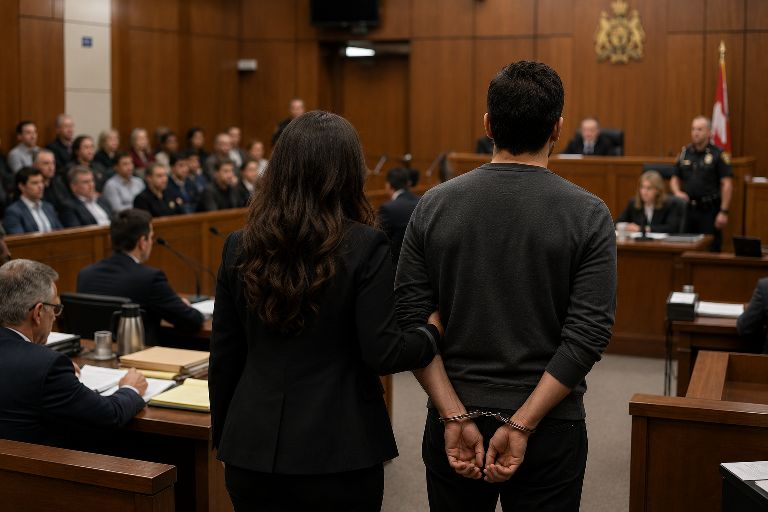
Breach of probation and fail to attend court charges in Ontario
Short answer: Breach of probation (s. 733.1) is failing, without reasonable excuse, to follow a condition of a probation order. Failing to attend court or to follow an undertaking or release order is charged under s. 145. Both are hybrid offences that create a new criminal charge, can lead to jail, make future bail harder and can reopen the sentence you were already serving. Acting quickly matters.
Civitas Law is a team of legal professionals under the leadership of lawyer Nasibeh Mehrpouyan, defending people charged with breach of probation, failure to attend court and failure to comply in Toronto and across the GTA, in English, French, Farsi, Russian and Serbian. If you have been arrested on a breach or on a warrant, start with our bail hearings page. If your charge is for breaking a condition of bail specifically, our breach of bail conditions page covers that in detail; this page deals with probation orders and missed court dates.
What is breach of probation under s. 733.1 of the Criminal Code?
A probation order is part of a sentence. It can follow a discharge, a suspended sentence, a fine or a jail term, and it can last up to three years. Every order requires you to keep the peace and be of good behaviour, appear before the court when required, and report any change of name, address or job. Most orders add optional conditions, and these are the ones that get breached: reporting to a probation officer, no contact with a named person, no weapons, counselling or treatment, an approved residence or curfew, and no alcohol or drugs.
Section 733.1 makes it an offence to fail or refuse, without reasonable excuse, to comply with the order. It is a hybrid offence: the Crown can proceed by indictment for serious or repeated breaches, with a higher maximum sentence, or by summary conviction, which is more common. Unlike bail conditions, which apply before your case is decided, probation conditions apply after sentence, and a breach can reach back into that sentence.
Fail to attend court and fail to comply charges under s. 145
Section 145 covers what happens when a person does not do what a release document says:
- Failure to attend court (s. 145(2) and (3)). You were given a date by an appearance notice, summons, undertaking or release order and did not show up. People also call this failure to appear.
- Failure to comply with an undertaking (s. 145(4)). An undertaking is the release form police give you at the scene or the station. Breaking a condition on it is this charge.
- Failure to comply with a release order (s. 145(5)). A release order is granted at a bail hearing. Breaking one of its conditions is this charge.
- Recognizance. The older word for a bail order, still used for peace bonds, where a breach is its own offence under s. 811.
Each s. 145 offence is hybrid, with a maximum of two years in jail by indictment. The Crown must prove the condition or court date existed, that you knew about it and that you failed without lawful excuse.
What a bench warrant means and how to fix a missed court date fast
When you miss a court date, the judge or justice of the peace issues a bench warrant for your arrest. In Toronto courts there are two kinds. A bench warrant with discretion is not enforced for a short window; if you appear before the deadline with a reasonable explanation, the warrant is cancelled and the case continues, usually without a new charge. A bench warrant without discretion means police can arrest you anywhere and hold you for a bail hearing, and the Crown will usually add a failure to attend court charge.
To fix a missed date fast:
- Call a lawyer the same day. We can find out whether a warrant was issued and whether it has discretion.
- Gather proof of the reason, such as a hospital record, an employer letter or the notice that showed the wrong date.
- If the warrant has discretion, go to court with your lawyer before the window closes.
- If it does not, arrange to surrender at the courthouse or a police division when bail court is sitting, so you are not held over a weekend.
Warrants do not expire, so never ignore one.
The lawful excuse defence and what the Crown must prove
Both s. 145 and s. 733.1 apply only when the failure was without lawful or reasonable excuse, and that phrase carries most of the defence work:
- Knowledge. The Supreme Court of Canada held in R. v. Zora that a bail breach requires proof that you knew about the condition and broke it knowingly or recklessly, and Ontario courts apply the same thinking to probation.
- Impossibility and emergencies. A hospital admission, a death in the family or being in custody somewhere else.
- Mistakes by others. A probation officer who moved an appointment, an address the court had wrong, or a conflicting family court order.
- Proof. In no-contact cases, who sent the message and whether the other person reached out first. In curfew checks, whether police actually confirmed you were absent.
Forgetting on its own is rarely enough, but the circumstances around it often are, and the earlier they are documented the stronger they become.
How a breach affects your original sentence and future bail
The original sentence. A breach of probation is a new charge, but it can also reopen the old case. If your original sentence was a conditional discharge, a conviction for breach lets the court revoke the discharge, enter a conviction on the original offence and sentence you for it. If it was a suspended sentence, the court can revoke the probation and impose any sentence it could have given at the start. Probation officers have discretion about reporting a breach, so keep communicating with yours.
Future bail. If you are charged with a s. 145 offence or a new offence while on release, the Crown can ask the court to cancel your existing release order, and the burden shifts to you to show why you should be released again. A record of breaches is what the Crown points to under the secondary ground. If you are denied bail, a bail review in the Superior Court of Justice may be available.
Record and immigration. Because both offences are hybrid, immigration law treats them as indictable, so permanent residents and foreign nationals should speak to our immigration law team before any plea.
How our team defends breach of probation charges in Toronto
We obtain the probation order or release document, the officer's notes and the court record, and check what you were actually told, signed and served with. Where the breach is technical, explained or a first one, we press the Crown for a withdrawal or a resolution that avoids a new conviction, and where a condition no longer makes sense we apply to vary the order instead of fighting about it. Where the Crown cannot prove knowledge, the condition or the absence of a lawful excuse, we run the trial in the Ontario Court of Justice.
Related orders have their own rules. A breach of a conditional sentence is dealt with at a hearing under s. 742.6 rather than by a new charge, and the court can order the rest of the sentence served in custody. A breach of a peace bond is an offence under s. 811.
Questions we hear often
General information, not legal advice. Every matter is different.
Is breach of probation a criminal offence in Canada?
Can you go to jail for breach of probation in Ontario?
What happens if you miss a court date in Ontario?
What is the difference between fail to comply and breach of probation?
What counts as a lawful excuse for missing court or breaching probation?
Will a breach charge affect my bail on my other case?
Can a probation order be changed?
How much does a breach of probation lawyer cost in Toronto?
Related services and guides
Criminal defence
All criminal charges in Toronto courts.
Breach of bail conditions
Fail to comply with a release order or undertaking.
Bail hearings
Getting released after an arrest.
Talk to our team
Book a consultation online or call (647) 271-1646 (the phone is answered 24/7). 30-minute consultation, $150 plus HST, paid when you book. Legal fees after that depend on the work involved, and we explain them in writing before you retain us.
Straightforward legal advice from a Toronto lawyer.
30-minute consultation, $150 plus HST, paid when you book. Personal injury matters start with a free 10-minute case review with the lawyer. Consultations are confidential.