
Human Trafficking and Procuring Charges Lawyer in Toronto
This page is for people charged with human trafficking, material benefit, procuring or advertising sexual services in Toronto, and for their families. Our team defends these charges, which carry some of the longest sentences in the Criminal Code and are often laid on the word of one complainant. Early, careful defence work matters.
30-minute consultation, $150 plus HST, paid when you book.
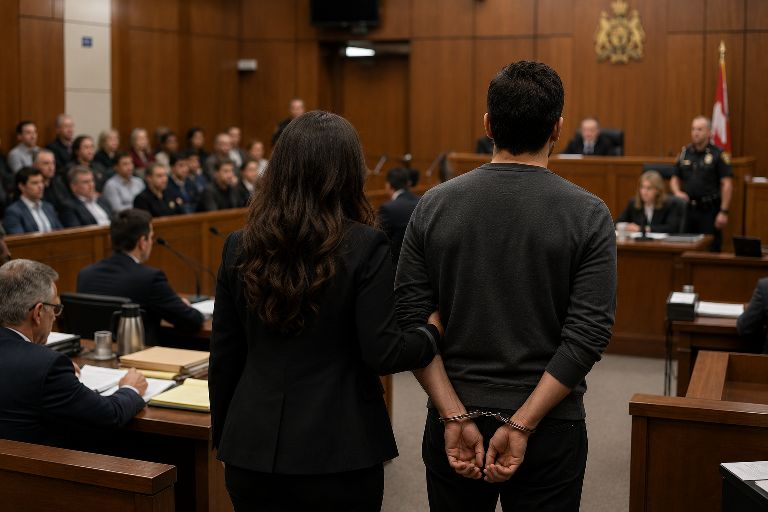
Human trafficking and procuring charges lawyer in Toronto
Short answer: Trafficking in persons (s. 279.01) means recruiting, moving, holding or controlling another person for the purpose of exploiting them. The Crown must prove exploitation: conduct that would make a reasonable person fear for their safety if they refused to provide labour or a service. Procuring (s. 286.3) and material benefit (s. 286.2) are separate offences that need no proof of exploitation.
Civitas Law is a team of legal professionals under the leadership of lawyer Nasibeh Mehrpouyan, defending people charged in Toronto and across the GTA, in English, French, Farsi, Russian and Serbian. We act for the person accused; if you need help leaving a situation of exploitation, Ontario's victim services are the right first call. Human trafficking arrests usually end in custody and a contested bail hearing, so call us the same day.
Trafficking in persons (s. 279.01 and 279.011)
Section 279.01 makes it an offence to recruit, transport, transfer, receive, hold, conceal or harbour a person, or to exercise control, direction or influence over a person's movements, for the purpose of exploiting them or helping someone else exploit them. Section 279.011 is the same offence where the complainant is under 18, with higher penalties. Two related counts are usually added: receiving a material benefit from trafficking (s. 279.02) and withholding or destroying identity documents (s. 279.03).
Two features make these charges unusually broad. First, the offence is complete once the Crown proves the conduct and the purpose; the complainant does not have to have been moved, held or harmed. Most Toronto cases involve no border and no physical restraint: an adult complainant who worked in the sex trade, and a boyfriend, roommate or driver said to have controlled the money, the ads, the hotel bookings or the hours. Second, s. 279.01(3) creates a presumption: if a person who is not being exploited lives with or is habitually in the company of a person who is, that is proof, unless there is evidence to the contrary, of control for the purpose of exploitation.
Material benefit, procuring and advertising (s. 286.2 to 286.4)
In 2014, after the Supreme Court of Canada struck down the old prostitution laws, Parliament repealed the offence of living on the avails of prostitution (the old s. 212) and replaced it with new offences. What people still call pimping is now charged as one or more of these:
- Material benefit from sexual services (s. 286.2). Receiving money or any other benefit knowing it comes from someone else's sexual services. There are exceptions for a legitimate living arrangement, for ordinary goods and services offered to the public, and for a benefit not obtained by exploiting or encouraging the person.
- Procuring (s. 286.3). Causing, encouraging or recruiting a person to offer sexual services, or controlling or influencing their movements for that purpose.
- Advertising sexual services (s. 286.4). Knowingly placing or promoting an advertisement for another person's sexual services.
A person who sells their own sexual services cannot be prosecuted for benefiting from, procuring or advertising their own services (s. 286.5). That immunity matters where two people worked together and one is now the complainant. Each of these offences carries a higher maximum, and in some cases a mandatory minimum, where the complainant was under 18.
What the Crown must prove: exploitation and fear for safety
For a trafficking charge, everything turns on exploitation, defined in s. 279.04. A person exploits another when they cause them to provide labour or a service by conduct that could reasonably be expected to make the other person believe their safety, or the safety of someone they know, would be threatened if they did not comply. The test is objective: what would a reasonable person in the complainant's position have feared, looking at the whole relationship? The complainant need not have actually been afraid, and consent is not a defence if exploitation is proven.
That is where the defence work lies. Many relationships in these cases were real, messy and consensual, with money shared in ways both people agreed to at the time. We use the messages, the money trail and the timeline to show what the arrangement actually was, and we hold the Crown to proving fear for safety rather than letting the label carry the case. For procuring and material benefit, exploitation is not an element, so the defence turns on knowledge, the s. 286.2 exceptions and whether the accused did what the complainant describes.
The complainant's evidence and common defences
Most human trafficking prosecutions in Toronto rest on the complainant's account, supported by phone records, text messages, online ads, hotel records and financial records. Investigations often begin with a hotel call, a traffic stop or a tip, and the complainant's first statement is taken in that moment. How the account developed over time, and whether it fits the documents, is at the centre of the trial.
Defences we commonly raise: no exploitation or fear for safety on the evidence; a consensual arrangement in which the complainant kept control of their own work and money; exaggeration of the accused's role, especially for drivers and roommates; the s. 286.5 immunity where the accused was also selling their own services; and Charter challenges to phone searches, surveillance and statements. Careful cross-examination remains the main way the defence tests the account against the record.
Bail, no-contact conditions and publication bans
Human trafficking is not reverse onus on its own, so the Crown must show why you should be held. In practice it almost always seeks detention, pointing to the seriousness of the charge and the risk of contact with the complainant. A strong release plan answers that: sureties who can supervise, a residence away from the complainant, no contact directly or through others, limits on internet and phone use, and surrender of passports.
The complainant's identity is protected by a publication ban under s. 486.4, which the court must grant on request. Your name is not covered by that ban, and police often announce arrests with names and photographs. We ask that bail hearing evidence be covered by the usual ban under s. 517.
Sentences, the registry and immigration consequences
Trafficking in persons carries a maximum of 14 years, or life where it involved kidnapping, aggravated assault, aggravated sexual assault or death, and Parliament attached mandatory minimums of several years to both the adult and the under-18 offences. Those minimums have been found unconstitutional in some cases and are still being tested in the courts; whether one applies to you depends on the charge and the current state of the law. Sentences for trafficking must be served consecutively to sentences for other offences arising from the same events (s. 279.05). Procuring carries a maximum of 14 years and material benefit a maximum of 10. A conviction for many of these offences also leads to registration under the Sex Offender Information Registration Act.
For a permanent resident or anyone on a permit, a conviction for trafficking, procuring or material benefit is serious criminality under immigration law because of the maximum sentence alone. We coordinate with our immigration team before any plea or sentencing position.
How our team defends human trafficking charges in Toronto
We begin with bail, because a release plan in the first days changes everything that follows. We obtain and organize the disclosure, which here means phone extractions, financial records and the complainant's statements, and build a timeline of the relationship from the documents. We review every search, production order and statement for Charter issues and bring applications where warranted. We negotiate with the Crown where the evidence does not support trafficking, and we prepare for trial from the start so that negotiation happens from strength.
Questions we hear often
General information, not legal advice. Every matter is different.
When was human trafficking made illegal in Canada?
Who investigates human trafficking in Canada?
What is the difference between human trafficking and procuring?
What is the minimum sentence for human trafficking in Canada?
Can the charges be dropped if the complainant does not want to proceed?
Can a permanent resident be deported for a human trafficking conviction?
How much does a human trafficking lawyer cost in Toronto?
Related services and guides
Criminal defence
All criminal charges in Toronto courts.
Bail hearings
Getting released after an arrest.
Sexual assault
Defence of sexual offence charges in Toronto.
Talk to our team
Book a consultation online or call (647) 271-1646 (the phone is answered 24/7). 30-minute consultation, $150 plus HST, paid when you book. Legal fees after that depend on the work involved, and we explain them in writing before you retain us.
Straightforward legal advice from a Toronto lawyer.
30-minute consultation, $150 plus HST, paid when you book. Personal injury matters start with a free 10-minute case review with the lawyer. Consultations are confidential.