
Sexual Assault Lawyer in Toronto
Civitas Law defends people charged with sexual assault in Toronto. If you have been accused under s. 271, 272 or 273 of the Criminal Code, or with sexual interference or voyeurism, this page explains what the charge means, how consent and records are dealt with at trial, and what happens to bail, your name and your record.
30-minute consultation, $150 plus HST, paid when you book.
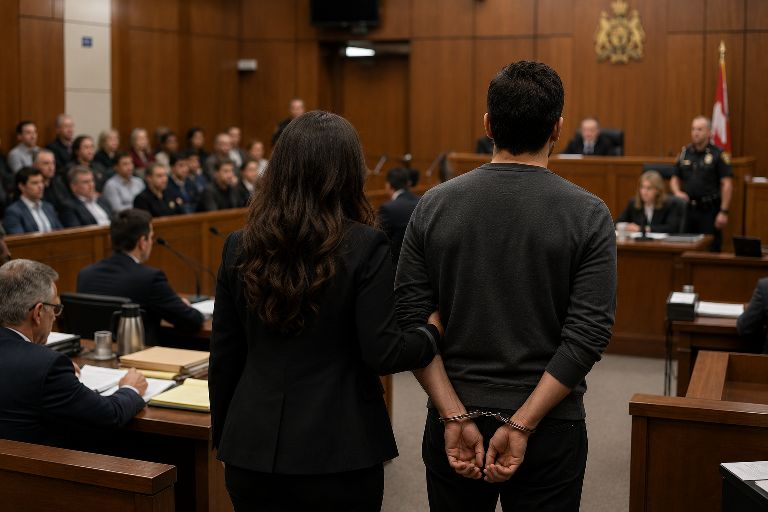
Sexual assault charges in Toronto
Short answer: Sexual assault is any assault of a sexual nature, charged under s. 271 of the Criminal Code. It is one of the most serious charges a person can face without anyone being physically injured, because a conviction brings a criminal record, often jail, registration as a sex offender and, for non-citizens, possible removal from Canada. Most trials turn on consent and credibility, not on forensic evidence.
Civitas Law is a team of legal professionals under the leadership of lawyer Nasibeh Mehrpouyan, defending people charged with sexual offences in Toronto and across the GTA, in English, French, Farsi, Russian and Serbian. We act for the accused person, not for complainants. A sexual assault charge almost always begins with an arrest, so if someone is in custody start with our bail hearings page and call us.
Sexual assault, sexual interference and related Criminal Code offences
Any non-consensual touching of a sexual nature, from a grab over clothing to intercourse, is sexual assault.
- Sexual assault (s. 271). A hybrid offence. By indictment the maximum is ten years, with higher maximums where the complainant is under 16.
- Sexual assault with a weapon, threats to a third party or causing bodily harm (s. 272). Indictable, maximum fourteen years, with a mandatory minimum where a firearm is used.
- Aggravated sexual assault (s. 273). Where the complainant is wounded, maimed, disfigured or their life is endangered. Maximum life.
- Sexual interference (s. 151) and invitation to sexual touching (s. 152). Touching a person under 16 for a sexual purpose, or inviting them to. Consent is not a defence, and a mistaken belief about age is a defence only if all reasonable steps were taken. Courts have struck down several of the mandatory minimums for these offences.
- Voyeurism (s. 162) and sharing an intimate image without consent (s. 162.1). Secretly recording someone where privacy is expected, or sharing a sexual image without consent.
There is no limitation period for an indictable offence, so allegations from decades ago can still be charged.
Consent and mistaken belief: the main defences to sexual assault
The touching is often not disputed; the question is whether the complainant consented and, if not, whether the accused honestly believed they did.
Consent (s. 273.1) means the voluntary agreement of the complainant to the sexual activity in question, at the time it happens. There is no consent where the person is unconscious or too intoxicated to agree, where it is obtained by abusing a position of trust or authority, or where the person says or shows that they do not agree.
Honest but mistaken belief in communicated consent (s. 273.2) is a defence only where the accused can point to something the complainant actually said or did that expressed agreement. It is not available where the belief came from intoxication, recklessness or wilful blindness, or where the accused did not take reasonable steps to find out. The Supreme Court of Canada confirmed in 2019 that assumptions, past encounters or the absence of a 'no' are not enough.
Credibility. Many cases are two accounts of the same evening. Under the W.(D.) framework, if the judge believes the accused, is left in reasonable doubt by the accused's evidence, or is not convinced beyond a reasonable doubt on the evidence they accept, the result is an acquittal. You do not have to prove anything or testify.
Texts, records and sexual history: the s. 276 and s. 278 rules
Parliament rewrote the evidence rules after the Ghomeshi trial in 2016, where complainants were confronted in cross-examination with their own messages. Three regimes now apply, and each requires the defence to apply to the judge in advance, in a closed hearing.
- Other sexual activity (s. 276). Evidence that the complainant had other sexual activity, with the accused or anyone else, cannot be used to suggest they were more likely to consent or less worthy of belief. It is admitted only for a specific, relevant purpose after a hearing.
- Records in the accused's hands (s. 278.92). If the defence holds the complainant's private records, such as texts, emails, photos or social media messages, it must apply before trial for permission to use them. The complainant may take part in that hearing with their own lawyer, and the Supreme Court upheld this regime in 2022.
- Third-party records (s. 278.1 to 278.91). Counselling notes or medical files held by someone else can only be obtained through a two-stage application to the trial judge.
In plain words, the defence can no longer surprise a complainant with their own messages, so we review your messages early and bring the applications on time.
Sentences, the sex offender registry and a criminal record
The Ontario Court of Appeal has said that a sexual assault involving penetration will usually attract a penitentiary sentence for an adult. Less intrusive touching can result in a shorter sentence, a conditional sentence or probation; a discharge is legally possible but rare.
- SOIRA registration. The Sex Offender Information Registration Act requires a person convicted of a designated sexual offence to register with police and report every year and whenever they move, for ten years, twenty years or life depending on the offence. Since October 2023, after the Supreme Court struck down automatic registration, the court must order it unless the person shows registration would be grossly disproportionate or unconnected to the registry's purpose; for some child and repeat offences it remains automatic. The registry is not public.
- DNA order. Sexual assault is a primary designated offence, so a sample is taken for the national data bank.
A conviction appears on vulnerable sector checks, which affects work with children, health care and licensed professions.
Bail, publication bans and what happens after a sexual assault charge
Arrest and bail. Police usually hold the accused for a bail hearing. The Crown often asks for strict conditions: no contact with the complainant, staying away from their home, school or workplace, and sometimes a surety. If the complainant is your partner, you may have to move out while the case is pending.
Publication ban. Under s. 486.4 the court orders, on request, that nothing identifying the complainant be published. The ban protects the complainant, not the accused: your name is on the public court record unless identifying you would identify the complainant, as in some family cases.
Court process. At the first appearance in the Ontario Court of Justice you receive initial disclosure, including the complainant's statement and any video interview, and no plea is entered. We review it, request what is missing, and then decide with you between a resolution and a trial. Release conditions stay in force until the case ends, often many months later.
Immigration and travel consequences of a sexual assault conviction
Sexual assault is punishable by up to ten years by indictment, which makes it 'serious criminality' under the Immigration and Refugee Protection Act. A conviction can make a permanent resident inadmissible and lead to a removal order, and a jail sentence of six months or more takes away the right to appeal that removal. Temporary residents can lose their status. Our immigration team works with the criminal defence team before any plea is entered. A conviction for a sexual offence also makes entry to the United States very difficult.
How our team defends a sexual assault charge in Toronto
We start by listening, in your language, without judgment. Then the work is methodical: we review the full disclosure; we gather your own evidence early, such as messages, payment records and witnesses; we identify Charter issues in the arrest, the phone search and any statement; we bring the s. 276 and s. 278 applications on time; and we talk frankly with the Crown about weaknesses in the case. Where a withdrawal, a peace bond or a lesser charge is realistic, we tell you; where it is not, we prepare for trial. No lawyer can promise a result.
Questions we hear often
General information, not legal advice. Every matter is different.
What are the odds of winning a sexual assault case?
Is sexual assault an indictable offence in Canada?
Can sexual assault charges be dropped if the complainant does not want to proceed?
Will my name be made public if I am charged with sexual assault?
Do I have to register as a sex offender if convicted?
Can a sexual assault conviction affect my immigration status?
How much does a sexual assault lawyer cost in Toronto?
Related services and guides
Criminal defence
All criminal charges in Toronto courts.
Bail hearings
Getting released after an arrest.
Assault and domestic assault
Assault, domestic assault and assault with a weapon.
Talk to our team
Book a consultation online or call (647) 271-1646 (the phone is answered 24/7). 30-minute consultation, $150 plus HST, paid when you book. Legal fees after that depend on the work involved, and we explain them in writing before you retain us.
Straightforward legal advice from a Toronto lawyer.
30-minute consultation, $150 plus HST, paid when you book. Personal injury matters start with a free 10-minute case review with the lawyer. Consultations are confidential.