
Conspiracy, Organized Crime and Firearms Lawyer in Toronto
Conspiracy, criminal organization and firearms charges usually arrive together, at the end of a long police investigation, with wiretaps and thousands of pages of disclosure. Our team defends people charged in these project cases in Toronto, from the first bail hearing through to trial in the Superior Court of Justice.
30-minute consultation, $150 plus HST, paid when you book.
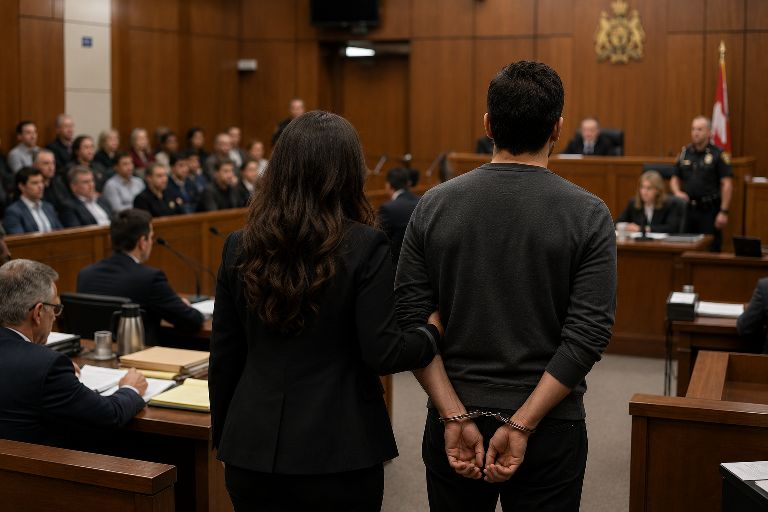
Conspiracy, organized crime and firearms lawyer in Toronto
Short answer: Conspiracy (s. 465) is an agreement between two or more people to commit an indictable offence; the Crown does not have to prove the crime was ever carried out. Criminal organization charges (s. 467.11 to 467.13) add consecutive sentences and reverse-onus bail. Firearms possession charges (s. 91, 92, 95) often ride alongside. These cases turn on disclosure, wiretap review and Charter applications.
Civitas Law is a team of legal professionals under the leadership of lawyer Nasibeh Mehrpouyan, defending people charged in Toronto and across the GTA, in English, French, Farsi, Russian and Serbian. Conspiracy and criminal organization charges almost always begin with an arrest at the end of a police project, so the first step is usually a contested bail hearing. Call us as soon as you learn of the arrest.
Conspiracy under s. 465: what the Crown must prove
Conspiracy is an agreement between two or more people to commit an indictable offence, together with a real intention to carry it out. The agreement is the crime: no step toward the offence needs to be taken, and the planned offence never has to happen. Conspiracy to commit murder carries a maximum of life imprisonment; conspiracy to commit any other indictable offence carries the same maximum as that offence. In Toronto the common forms are conspiracy to traffic in drugs, conspiracy to commit robbery and conspiracy to commit murder.
To convict, the Crown must prove that a conspiracy existed, that the accused was probably a member of it, and then, using evidence that applies to the accused personally, that they were a member beyond a reasonable doubt. This approach lets the Crown use what co-conspirators said and did in furtherance of the plan against everyone in it. The defence asks whether there was a true agreement or merely talk, and whether the accused knew what was actually planned.
Criminal organization offences (s. 467.11 to 467.13)
A criminal organization under s. 467.1 is a group of three or more people, in or outside Canada, whose main purpose or one of whose main activities is committing serious offences that would likely bring the group a material benefit. A group that forms by chance to commit a single offence does not count. Three offences build on that definition: participating in or contributing to the activities of a criminal organization (s. 467.11), committing an indictable offence for the benefit of, at the direction of, or in association with one (s. 467.12), and instructing anyone to commit an offence for it (s. 467.13).
These counts change the whole case. A sentence for a criminal organization offence must be served consecutively to the sentence for the underlying offence, the court can delay parole eligibility, and bail is reverse onus. Whether a loosely connected group of friends actually meets the legal definition is one of the first things we test, because when that count falls away, the sentencing and bail pictures both change.
Firearms offences: s. 91, 92, 95, 99 and 117.01
The firearms charges we see most:
- Unauthorized possession (s. 91 and 92). Possessing a firearm without a licence and, for restricted or prohibited firearms, a registration certificate. Section 92 adds proof that you knew you were not authorized.
- Possession of a loaded prohibited or restricted firearm (s. 95). A handgun that is loaded or has ammunition readily available, with no authorization. The mandatory minimums for this offence were struck down by the Supreme Court of Canada and later repealed by Parliament, but it still carries one of the highest maximum sentences of any possession offence.
- Weapons trafficking (s. 99). Transferring or offering to transfer a firearm without authority, with mandatory minimums in many circumstances.
- Possession contrary to a prohibition order (s. 117.01). Having any firearm or ammunition while under a court order not to.
In almost every firearms case the central questions are possession and knowledge: whose gun was it, who knew it was there, and who had control over it. A firearm found in a shared car, a shared apartment or a bag several people handled is not automatically yours in law. We also examine every search, because a gun found through an unlawful search can be excluded under s. 24(2) of the Charter.
Police project cases: wiretaps, disclosure and co-accused
Toronto Police, the OPP and the RCMP run long investigations they call projects, and the ones aimed at firearms and street-level groups are run by what people call the guns and gangs unit. A project typically involves months of surveillance, confidential informants, production orders, tracking warrants and, above all, wiretap authorizations under Part VI of the Criminal Code. It ends with dozens of arrests on the same morning and charges spread across many accused.
Three things define the defence. First, disclosure volume: tens of thousands of intercepted calls, messages and surveillance notes, delivered over many months. Reviewing it properly is slow and necessary, and delay in disclosure counts against the Crown under the Jordan time limits (18 months in the Ontario Court of Justice, 30 months in the Superior Court of Justice). Second, the wiretap: we review the affidavit used to obtain the authorization and, where it was inaccurate or incomplete, bring a Garofoli application to exclude the intercepts under s. 8 of the Charter. Third, the co-accused: the Crown prefers one large joint trial, often by direct indictment. Where evidence against others would unfairly colour your case, we apply for severance so that you are tried on your own evidence.
Bail in project and firearms cases
Bail is the first fight and often the hardest. For criminal organization offences, for weapons trafficking and, since the 2024 amendments, for most serious firearms possession offences including s. 95, the onus is reversed: the accused must show why release is justified.
A release plan has to answer those concerns: one or more sureties who can pledge and supervise, a residence away from co-accused, house arrest or a curfew, no-contact conditions and sometimes electronic monitoring. We prepare sureties for cross-examination and present the weaknesses in the Crown's case at the hearing. If bail is denied, a bail review in the Superior Court of Justice is available.
Penalties, records and immigration consequences
Sentences in these cases are measured in years. Conspiracy carries the same range as the planned offence, a criminal organization conviction adds consecutive time, and firearms offences bring mandatory minimums in some cases and a lengthy weapons prohibition in nearly all. Forfeiture of cash, phones and vehicles is routine, and proceeds of crime counts often ride along.
For anyone who is not a Canadian citizen, a conviction for an offence with a maximum of ten years or more, or a sentence of more than six months, is serious criminality under immigration law. A permanent resident can lose status and, with a sentence of six months or more, loses the right to appeal. Almost every charge on this page clears that bar, so our immigration team is involved before any plea.
How our team defends conspiracy and firearms charges
We start at bail and build the release plan the same week. We then take control of disclosure: indexing it, tracking what is missing and recording delay in writing. We review every authorization and warrant for Charter problems, assess the evidence against you specifically rather than the group, and decide with you whether the case calls for severance, a Garofoli hearing, a Jordan application, negotiation with the Crown to withdraw the criminal organization count, or a trial. At every stage you will understand the evidence against you and the choices in front of you.
Questions we hear often
General information, not legal advice. Every matter is different.
What is a conspiracy charge in Canada?
Can you be convicted of conspiracy if the crime never happened?
What are the penalties for gun charges in Canada?
Is there still a mandatory minimum sentence for gun charges in Ontario?
What counts as a criminal organization under the Criminal Code?
Can I get bail on a gun charge in Toronto?
How much does a conspiracy or firearms lawyer cost in Toronto?
Related services and guides
Criminal defence
All criminal charges in Toronto courts.
Bail hearings
Getting released after an arrest.
Drug charges
Trafficking and possession for the purpose, often charged with conspiracy.
Talk to our team
Book a consultation online or call (647) 271-1646 (the phone is answered 24/7). 30-minute consultation, $150 plus HST, paid when you book. Legal fees after that depend on the work involved, and we explain them in writing before you retain us.
Straightforward legal advice from a Toronto lawyer.
30-minute consultation, $150 plus HST, paid when you book. Personal injury matters start with a free 10-minute case review with the lawyer. Consultations are confidential.