
Robbery, Kidnapping and Forcible Confinement Lawyer in Toronto
Civitas Law defends people charged with robbery, kidnapping and forcible confinement in Toronto courts. These charges are usually laid together after an arrest, and the stakes are high: robbery carries a maximum of life imprisonment and, in some firearm cases, a mandatory minimum. This page explains each offence, the sentences, bail and how we defend them.
30-minute consultation, $150 plus HST, paid when you book.
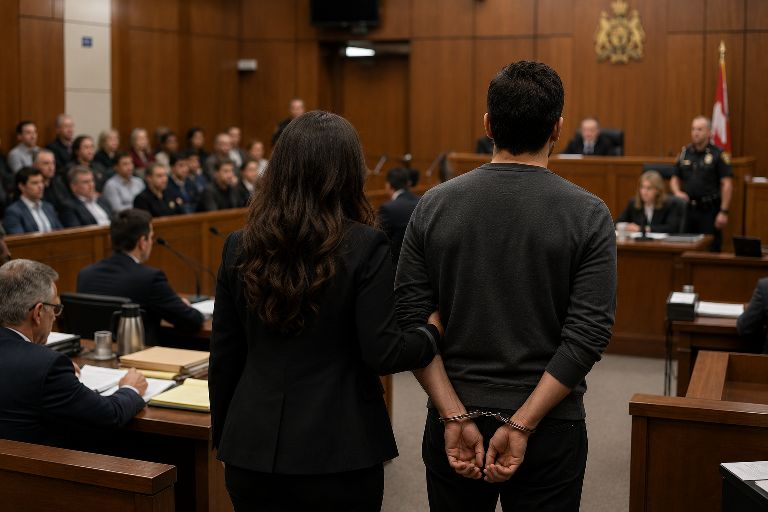
Robbery, kidnapping and forcible confinement charges in Toronto
Short answer: Robbery is theft with violence, the threat of violence or a weapon (s. 343 of the Criminal Code). Forcible confinement is holding someone against their will without lawful authority (s. 279(2)). Kidnapping is taking or carrying a person away (s. 279(1)). All three are serious charges that usually start with an arrest and a bail hearing, and robbery carries a maximum of life imprisonment.
Civitas Law is a team of legal professionals under the leadership of lawyer Nasibeh Mehrpouyan, defending people charged with robbery, kidnapping and forcible confinement in Toronto and across the GTA, in English, French, Farsi, Russian and Serbian. These charges almost always begin with an arrest, so if someone is in custody start with our bail hearings page and call us.
What are the four types of robbery under s. 343?
Section 343 of the Criminal Code sets out four ways robbery can be committed. The Crown needs to prove only one.
- Stealing with violence or threats of violence to a person or property, to get the property or to stop the victim resisting.
- Stealing and wounding, beating, striking or using any personal violence on the victim at the time or immediately before or after.
- Assault with intent to steal. Nothing has to be taken; a shove and a demand for a phone is enough.
- Stealing while armed with an offensive weapon or an imitation of one, even if it is never shown.
Robbery is a straight indictable offence with a maximum of life imprisonment, so a discharge is not available and neither is a conditional sentence. The connection between the force and the taking is what separates robbery from theft and assault charged separately, and it is often where the defence begins.
Robbery with a firearm (s. 344) and the mandatory minimum sentences
Section 344 sets the punishment. Where a restricted or prohibited firearm is used, or any firearm is used in a robbery for a criminal organization, there is a mandatory minimum of five years for a first offence and a longer minimum for a repeat. In 2023 the Supreme Court of Canada upheld these minimums in Hilbach, so they remain in force.
For an ordinary, non-restricted firearm, Parliament used to impose a separate minimum. Bill C-5, in force since late 2022, repealed it, and the Supreme Court's decision in Hills that same winter struck down a similar minimum for firing a gun recklessly at a building. In plain words: a judge sentencing a robbery with a non-restricted firearm now has discretion, while a robbery with a handgun still carries a fixed floor. Whether the object was a firearm at all, whether it was 'used' and who had it are all live issues.
How many years is the sentence for robbery in Ontario?
There is no single answer. Outside the firearm cases there is no minimum, so the sentence depends on the kind of robbery, the harm, the accused's record and age.
- Home invasion robberies are the most serious. Ontario courts impose substantial penitentiary sentences even on first offenders.
- Commercial robberies of a store, bank or pharmacy with a weapon or a note usually mean a penitentiary sentence for an adult.
- Street robberies without a weapon or serious injury cover the widest range, and for a youthful first offender the Court of Appeal has recognized that rehabilitation must be given real weight.
- Young persons under 18 are sentenced under the Youth Criminal Justice Act, which puts rehabilitation first and treats custody as a last resort; see our youth criminal defence page.
What is forcible confinement under the Criminal Code?
Forcible confinement means keeping a person in a place against their will, for any meaningful period of time, without lawful authority to do so. Section 279(2) of the Criminal Code makes it an offence for anyone who, 'without lawful authority, confines, imprisons or forcibly seizes another person'. No movement and no weapon is required. Blocking a doorway or taking someone's keys so they cannot leave can be charged if the restraint is more than momentary.
- It is a hybrid offence. By indictment the maximum is ten years; there is no mandatory minimum for forcible confinement on its own.
- Resistance. Under s. 279(3), the fact that the person did not resist is not a defence unless the accused proves the lack of resistance was not caused by threats, duress, force or a show of force.
- Domestic incidents. This charge is often added to a domestic assault charge when one partner stops the other from leaving a room or a car, and it turns a case that might have ended in a peace bond into one the Crown treats as serious intimate partner violence. Whether a brief restraint during an argument amounts to criminal confinement, and whether the complainant was free to leave, are the usual battlegrounds.
Kidnapping versus forcible confinement (s. 279)
Kidnapping (s. 279(1)) is taking, carrying away or transporting a person against their will, with intent to confine them, send them out of Canada, or hold them for ransom or service. The taking and moving is the heart of it: every kidnapping includes a confinement, but a confinement without movement is not a kidnapping. Kidnapping is a straight indictable offence with a maximum of life, and Parliament has attached mandatory minimums where a firearm is used or the person taken is under 16, some of which face constitutional challenge.
Related charges often laid alongside: hostage taking (s. 279.1), where a person is confined to force a third party to act; parental abduction (s. 282 and 283), where a parent takes a child in breach of a parenting order, a charge that usually grows out of a family dispute; and extortion (s. 346), which often accompanies a confinement over a debt. Whether the complainant went willingly at the start is usually the key question.
Identification evidence and how robbery charges are defended
Most robbers do not know their victims, so the central question at many robbery trials is not whether a robbery happened but whether the Crown can prove who did it. The 'points to prove' are that property was taken or an assault with intent to steal occurred, that violence, threats or a weapon were used, and that the accused is the person responsible.
- Eyewitness identification. Courts have long recognized that honest, confident witnesses are often wrong after a brief, frightening encounter with a stranger, so we examine how the photo lineup was run and what description was given first.
- Video and phone evidence. CCTV, doorbell cameras, cell tower records and rideshare data are in most robbery files now. Their quality, timing and chain of custody can be challenged, and the same records sometimes place the accused elsewhere.
- Charter breaches. Arrests on thin grounds, warrantless phone searches and a denied call to a lawyer are common, and evidence obtained that way can be excluded under s. 24(2).
- The elements. Was the item really a weapon? Was the force connected to the taking? Was there intent to steal at the moment of the assault?
Bail for robbery and kidnapping charges: when the onus is reversed
For most charges the Crown must show cause why a person should be detained. Section 515(6) of the Criminal Code reverses that onus in several situations common in robbery and kidnapping files: robbery or kidnapping alleged to have been committed with a firearm; any indictable offence allegedly committed while already on release for another indictable offence; offences for a criminal organization; and certain firearms offences, including possession of a loaded restricted firearm (s. 95).
A reverse onus does not make detention automatic. It means we come to court with a plan: a strong surety, a residence, conditions that answer the Crown's concerns and, in the most serious cases, electronic monitoring. If bail is denied, a bail review in the Superior Court of Justice is available; our guide to show cause hearings explains what to expect.
Questions we hear often
General information, not legal advice. Every matter is different.
What are the points to prove for robbery?
What is the minimum sentence for forcible confinement?
What is the difference between robbery and theft?
Can a robbery charge be reduced to theft?
Can a youth be charged with robbery in Toronto?
Will I get bail on a robbery charge?
How much does a criminal lawyer cost in Toronto?
Related services and guides
Criminal defence
All criminal charges in Toronto courts.
Bail hearings
Getting released after an arrest.
Youth criminal defence
Young persons charged under the Youth Criminal Justice Act.
Talk to our team
Book a consultation online or call (647) 271-1646 (the phone is answered 24/7). 30-minute consultation, $150 plus HST, paid when you book. Legal fees after that depend on the work involved, and we explain them in writing before you retain us.
Straightforward legal advice from a Toronto lawyer.
30-minute consultation, $150 plus HST, paid when you book. Personal injury matters start with a free 10-minute case review with the lawyer. Consultations are confidential.