
Criminal Harassment Lawyer in Toronto
Civitas Law defends people charged with criminal harassment in Toronto courts. Criminal harassment under section 264 of the Criminal Code covers following, monitoring, repeated contact, watching a home or workplace and threatening conduct that causes a reasonable fear for safety. This page explains what the Crown must prove, the penalties, bail conditions, ways a case can resolve and what to do first.
30-minute consultation, $150 plus HST, paid when you book.
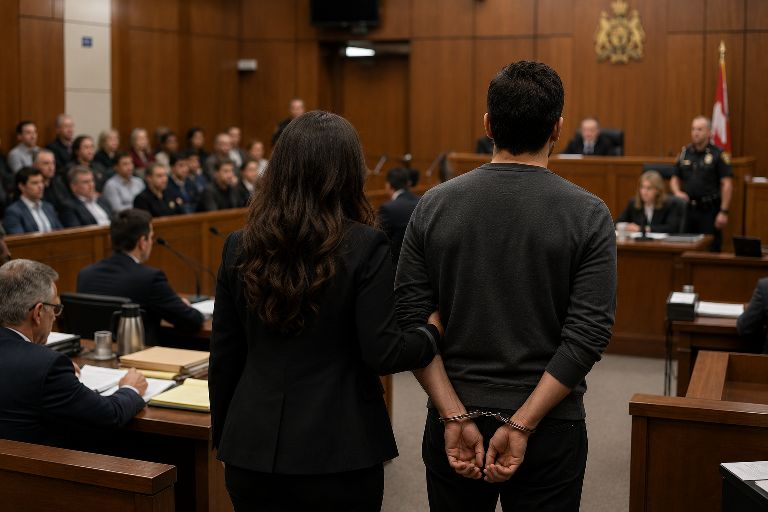
Criminal harassment charges in Toronto
Short answer: Criminal harassment, often called stalking, is an offence under section 264 of the Criminal Code. The Crown must prove that the accused repeatedly followed, monitored or contacted someone, watched their home or workplace, or threatened them, knowing or being reckless that the person felt harassed, and that the conduct caused the person to reasonably fear for their safety. It is a hybrid offence with a maximum of 10 years in prison when the Crown proceeds by indictment.
Civitas Law is a team of legal professionals under the leadership of lawyer Nasibeh Mehrpouyan, defending people charged with criminal offences in Toronto and across the GTA, in English, French, Farsi, Russian and Serbian. We act for the person accused. Criminal harassment charges often follow the end of a relationship, a dispute between neighbours or co-workers, or a run of messages on social media, and they usually come with strict no-contact conditions from the first day.
This page explains the offence as it reads in section 264 of the Criminal Code as of November 2026, what the Crown has to prove, the possible penalties, how bail and release conditions work, and the ways these cases are resolved in Toronto courts. If someone is in custody now, start with our bail hearings page. For an overview of every charge we defend, see our Toronto criminal defence page.
What counts as criminal harassment under section 264?
Section 264(2) lists the kinds of conduct that can amount to criminal harassment. The conduct can happen in person, by phone, by text, through social media or by any other means.
- Repeatedly following the person or anyone known to them from place to place.
- Monitoring the person's location, movements, actions or social interactions, or those of anyone known to them. This paragraph was added to the section recently and captures conduct such as tracking a phone or a vehicle, or checking someone's accounts.
- Repeatedly communicating with the person or anyone known to them, directly or indirectly. Calls, texts, emails, comments and messages sent through friends or family can all count.
- Besetting or watching the home, workplace or any place where the person lives, works, carries on business or happens to be.
- Engaging in threatening conduct directed at the person, a member of their family or someone known to them, including threats aimed at an animal they know.
The section now also says, for greater certainty, that a person's safety includes their psychological safety. That means the Crown does not have to show a fear of physical harm in every case; a reasonable fear for psychological safety can be enough.
What the Crown must prove for criminal harassment
Everyone charged is presumed innocent. To convict, the Crown must prove each of these elements beyond a reasonable doubt:
- the accused engaged in one of the forms of conduct listed in s. 264(2);
- the complainant was harassed, meaning the conduct went beyond annoyance and left them tormented, troubled or badgered;
- the accused knew the complainant was harassed, or was reckless or wilfully blind about it;
- the conduct caused the complainant to fear for their safety or the safety of someone known to them; and
- that fear was reasonable in all the circumstances.
The word 'repeatedly' in the following and communicating paragraphs means more than once, but Ontario courts look at the whole context: two messages in a busy co-parenting relationship are not the same as two hundred unanswered messages after being asked to stop. Watching and threatening conduct do not need to be repeated, so a single serious incident can be charged if it meets the other elements.
Criminal harassment is often charged alongside related offences, such as uttering threats under s. 264.1, mischief, breach of a release order or harassing communications under s. 372 of the Criminal Code. Where the parties were in an intimate relationship, the case is usually handled in the same way as a domestic assault charge.
Online harassment, texting and social media
Many criminal harassment cases in Toronto are built almost entirely on digital evidence: screenshots, call logs, social media posts, location data and messages sent from new accounts after an old one was blocked. Repeatedly contacting someone through new phone numbers or accounts, posting about them, or messaging their friends and employer can all be charged.
Digital cases raise their own questions. Screenshots can be incomplete or taken out of order, accounts can be shared or impersonated, and the full message history may show two people in an ongoing argument rather than one person pursuing another. Getting the complete record, including your own phone and accounts, is an early priority. Do not delete messages or accounts after a charge: that can look like destroying evidence and may remove material that helps your defence.
What is the sentence for criminal harassment in Ontario?
Criminal harassment is a hybrid offence. The Crown chooses whether to proceed summarily or by indictment, and that choice sets the maximum sentence.
- By indictment: a maximum of 10 years in prison.
- Summarily: the general summary maximum in the Criminal Code, which is two years less a day in jail, a $5,000 fine, or both.
- No mandatory minimum. Because there is no minimum and the maximum is under 14 years, an absolute or conditional discharge, a suspended sentence with probation and a conditional sentence served in the community are all legally available.
Section 264(4) requires the judge to treat it as aggravating if the harassment was committed while the accused was bound by a court order, such as a peace bond, a restraining order or a release order, that protected the same person. Other common aggravating factors are a history of abuse, the length of the conduct and its effect on the complainant. Mitigating factors include a clean record, an early guilty plea, counselling and stable support. Sentencing also usually includes a probation order with no-contact terms, and the court may make a weapons prohibition and a DNA order.
What does a criminal harassment lawyer cost in Toronto?
Criminal defence fees depend on the charge, the volume of disclosure, whether there is a bail hearing, how many court appearances are needed and whether the case goes to trial. Too few Toronto firms publish a fee for this type of charge to give a reliable market figure, so we do not show one. For context, the ranges Ontario firms do publish for other charges are below.
| Service | Typical fee | Range published |
|---|---|---|
| Impaired driving or over 80, first offence, resolved without trial | $5,900 | $3,500 to $15,000 |
| Simple assault, mischief or theft under $5,000 | $5,750 | $1,500 to $15,000 |
| Hourly rate, criminal defence | about $410 an hour | $75 to $800 an hour |
How we measured this: we reviewed fee ranges that Ontario criminal defence firms publish on their own websites, checked in November 2026. These are typical market ranges, not Civitas Law's fees, and they usually exclude HST and disbursements. Only a few firms publish criminal fees, so a figure is shown only where at least three firms published one. Civitas Law explains its fee in writing before you retain us. The 30-minute consultation is $150 plus HST, paid when you book.
Bail and no-contact conditions after a harassment charge
Most people charged with criminal harassment are released by police on an undertaking or by a court on a release order. The conditions almost always include no contact, direct or indirect, with the complainant and their family, and an order to stay away from their home, workplace or school. Indirect contact includes messages through friends, posting about the person online or asking someone else to pass on a message.
- Follow every condition exactly. A single message, even a reply to one the complainant sent, can lead to a new charge of failing to comply and to a bail hearing with a reverse onus.
- Shared homes and children. If you lived with the complainant, the conditions may stop you returning home. Arrangements to collect belongings usually go through police, and parenting time may need to be dealt with in a family court case.
- Changing conditions. Conditions can sometimes be changed with Crown consent or by a court application. Our bail variation page explains how.
If you are accused of breaching a condition, see our page on breach of bail conditions.
How criminal harassment charges are defended
Each case turns on its own facts, but most defences focus on one or more of the elements the Crown must prove.
- The conduct does not fit s. 264(2). A few messages about a shared child, a business debt or the return of property may not be repeated communication of the kind the section targets.
- No knowledge or recklessness. If the complainant kept contact going, replied warmly or started conversations, it may not be proven that the accused knew they felt harassed.
- No reasonable fear. The Crown must prove the complainant actually feared for their safety and that the fear was reasonable. The full history of the relationship matters here.
- Lawful authority. Some contact is legally permitted, for example under a family court order, through a lawyer or as part of a lawful job.
- Identity and reliability of digital evidence. The Crown must prove the accused sent the messages or made the posts, which can be contested where accounts are shared, anonymous or impersonated.
- Charter issues. Searches of phones and accounts, the arrest and any statement to police must comply with the Charter.
No lawyer can promise a result. Our team reviews the full disclosure with you and explains which issues are realistic in your case.
Can a criminal harassment charge be withdrawn or resolved with a peace bond?
Many harassment cases in Toronto do not end in a trial. Depending on the evidence, the history and the complainant's position, a case may resolve in one of these ways:
- Withdrawal by the Crown where there is no reasonable prospect of conviction or it is not in the public interest to continue.
- A peace bond under s. 810, where the charge is withdrawn and the accused agrees to keep the peace and follow conditions, usually for 12 months. A peace bond is not a criminal conviction.
- Diversion or an alternative measure, where the Crown agrees and the case qualifies, often with counselling.
- A plea to a lesser or different charge, sometimes with a discharge.
- A trial, where the evidence does not support the charge or no fair resolution is offered.
The complainant's wishes are important but do not decide the case. The decision to continue or withdraw belongs to the Crown.
Criminal record, immigration and other consequences
A conviction for criminal harassment creates a criminal record, which can affect jobs, volunteering, travel and professional licences. A discharge is not a conviction, and its record is kept from disclosure after one year (absolute) or three years (conditional). A conviction can later be the subject of a record suspension from the Parole Board of Canada.
Because criminal harassment carries a maximum of 10 years, a conviction is serious criminality under the Immigration and Refugee Protection Act for permanent residents and foreign nationals, even if the Crown proceeded summarily. If you are not a Canadian citizen, read our page on the immigration consequences of criminal charges and tell us your status at the first meeting, before any plea is discussed.
Where criminal harassment cases are heard in Toronto
Most criminal harassment cases in Toronto are heard in the Ontario Court of Justice at the Toronto Courthouse, 10 Armoury Street, which also runs the intimate partner violence courts. Bail hearings are held at the Toronto Regional Bail Centre, 2201 Finch Avenue West. If the Crown proceeds by indictment and the accused elects a trial in the Superior Court of Justice, the case moves to 361 University Avenue. Your undertaking or release order names the courthouse and the date of your first appearance. Court location details are on the Ontario Court of Justice website.
What to do if you are charged with criminal harassment
- Read your release papers and follow every condition from the first minute.
- Do not contact the complainant, even to apologize or explain, and do not post about them or the case.
- Keep your evidence. Save messages, call logs, emails and screenshots, and write down dates while they are fresh. Do not delete accounts.
- Do not give a statement to police without legal advice. You have the right to speak to a lawyer.
- Attend court on the date on your paperwork. Missing a date leads to a warrant.
- Get advice early. Our team offers a paid consultation, $150 plus HST for 30 minutes, paid when booking. You can book a consultation online or call (647) 271-1646. Our office is at 4789 Yonge Street, Suite 402, Toronto, at Yonge and Sheppard in North York.
Questions we hear often
General information, not legal advice. Every matter is different.
What is criminal harassment in Canada?
Is criminal harassment the same as stalking?
What is the maximum sentence for criminal harassment in Ontario?
Can you get a discharge for criminal harassment?
How many messages count as criminal harassment?
Can one incident be criminal harassment?
Is texting or messaging on social media criminal harassment?
Can criminal harassment be psychological?
What does the Crown need to prove for criminal harassment?
Can a criminal harassment charge be dropped if the victim does not want to proceed?
Can criminal harassment be resolved with a peace bond?
Will I get a criminal record for criminal harassment?
How long does criminal harassment stay on your record?
Can I contact the complainant if they contact me first?
What should I do if I am falsely accused of criminal harassment?
Is criminal harassment a serious offence for immigration?
Can criminal harassment charges affect child custody?
What is the difference between criminal harassment and uttering threats?
What is the difference between harassment and criminal harassment?
Do I need a lawyer for a criminal harassment charge?
Related services and guides
Criminal defence
All criminal charges in Toronto courts.
Uttering threats
Threats charges under s. 264.1.
Peace bonds
Section 810 peace bonds and their conditions.
Domestic assault
Intimate partner charges in Toronto courts.
Bail hearings
Getting released after an arrest.
Immigration consequences
How a charge can affect PR and visa status.
Talk to our team
Book a consultation online or call (647) 271-1646 (the phone is answered 24/7). 30-minute consultation, $150 plus HST, paid when you book. Legal fees after that depend on the work involved, and we explain them in writing before you retain us.
Straightforward legal advice from a Toronto lawyer.
30-minute consultation, $150 plus HST, paid when you book. Personal injury matters start with a free 10-minute case review with the lawyer. Consultations are confidential.