
Immigration Consequences of Criminal Charges in Canada
For anyone who is not a Canadian citizen, a criminal charge can affect permanent residence, a work or study permit, a sponsorship or a citizenship application. This page explains criminality and serious criminality under section 36 of the Immigration and Refugee Protection Act, the six-month rule for appeals, why discharges and the form of a plea matter, and how criminal and immigration advice fit together.
30-minute consultation, $150 plus HST, paid when you book.
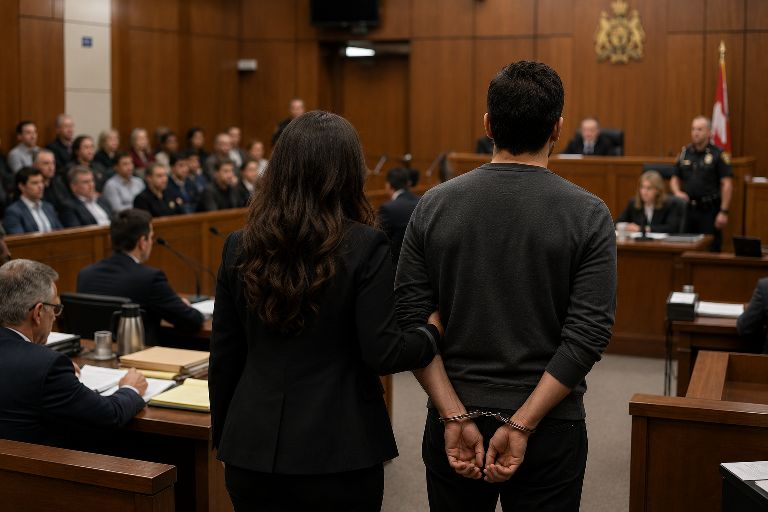
How a criminal charge can affect your immigration status
Short answer: A charge alone does not make a permanent resident or foreign national inadmissible to Canada, but a conviction can. Under section 36 of the Immigration and Refugee Protection Act, a permanent resident is inadmissible for serious criminality if convicted of an offence with a maximum of at least 10 years, or if sentenced to more than six months in prison. A foreign national, such as a visitor, student or worker, can be inadmissible for any conviction of an offence that can be prosecuted by indictment. A jail term of six months or more usually removes a permanent resident's right to appeal a removal order.
Civitas Law is a team of legal professionals under the leadership of lawyer Nasibeh Mehrpouyan, practising both criminal defence and immigration law in Toronto, in English, French, Farsi, Russian and Serbian. Many of the people we meet are permanent residents, international students, workers or refugee claimants for whom the immigration result of a criminal case matters as much as the sentence. Because both practices are under one roof, the criminal file and the immigration questions can be planned together before any plea or sentencing decision.
This page is general information on the law as of November 2026. The rules depend on your exact status, the offence, how the Crown proceeds and the sentence, so the details of your case need individual advice.
Criminality and serious criminality under section 36
The grounds of criminal inadmissibility are in section 36 of the Immigration and Refugee Protection Act.
- Serious criminality, s. 36(1), applies to permanent residents and foreign nationals. It covers a conviction in Canada under a federal law for an offence with a maximum sentence of at least 10 years, or any federal conviction where a term of imprisonment of more than six months was imposed. It also covers convictions and conduct outside Canada that would carry a 10-year maximum here.
- Criminality, s. 36(2), applies only to foreign nationals. It covers a conviction in Canada for an offence that can be prosecuted by indictment, two convictions for offences arising from separate occurrences, and similar convictions or conduct outside Canada.
Several rules in s. 36(3) make the reach of these grounds wider or narrower:
- Hybrid offences count as indictable. An offence that can be prosecuted either way is deemed indictable for immigration purposes, even if the Crown proceeded summarily. Most common Criminal Code offences, including assault, theft under $5,000 and mischief, are hybrid.
- The maximum, not the sentence, is the first test. Impaired driving, assault causing bodily harm, criminal harassment and many fraud and drug offences have a maximum of 10 years or more, so a conviction is serious criminality even with a small fine.
- Record suspensions and acquittals. A conviction covered by a record suspension in force, or an offence that ended in a final acquittal, does not create inadmissibility.
- Youth sentences and contraventions. Youth sentences under the Youth Criminal Justice Act and designated contraventions do not create inadmissibility.
Permanent residents, visitors, students and workers
Permanent residents are affected only by serious criminality in Canada. A conviction for an offence with a 10-year or higher maximum, or a sentence of more than six months, can lead to a report under s. 44 of the Act and a hearing before the Immigration Division of the Immigration and Refugee Board. If the Division finds the person inadmissible, it makes a deportation order, which ends permanent resident status once it is final.
Foreign nationals, including visitors, international students, temporary workers and people waiting for permanent residence, are affected by both grounds. A single conviction for a hybrid offence can lead to a removal order, the refusal of an extension or a permanent residence application, or the cancellation of a permit. Inadmissibility can also affect a spouse's sponsorship of the person.
Refugee claimants and protected persons face additional rules: serious criminality can affect eligibility to have a claim referred, and can expose a protected person to removal in limited cases. These files need careful coordination between the criminal and immigration sides.
Citizenship applicants can be prohibited from being granted citizenship while charged with an indictable offence, while serving a sentence or on probation, and for a period after certain convictions. The prohibitions are in section 22 of the Citizenship Act, including a bar for certain convictions in the four years before the application.
The six-month rule and appeals to the Immigration Appeal Division
A permanent resident who receives a deportation order can usually appeal to the Immigration Appeal Division, which can allow the person to stay on humanitarian and compassionate grounds, such as how long they have lived in Canada, their family, their rehabilitation and the hardship removal would cause. Under s. 64 of the Act, that appeal is not available where the inadmissibility is for serious criminality punished in Canada by a term of imprisonment of at least six months.
That is why the length of a jail sentence can decide whether a permanent resident keeps any route to stay in Canada. The Supreme Court of Canada has held that a sentencing judge may take immigration consequences into account in choosing a fit sentence, though it cannot impose an inappropriate sentence just to avoid them. It has also held that a conditional sentence served in the community is not a 'term of imprisonment' for the more-than-six-months test in s. 36(1)(a).
Why the form of a plea and the sentence matter
Decisions in the criminal case can change the immigration result. These are the questions our team looks at before any resolution is discussed:
- Which offence. Pleading to an offence with a maximum under 10 years, where the facts support it, can keep a permanent resident outside serious criminality.
- Discharge or conviction. An absolute or conditional discharge under s. 730 of the Criminal Code is not a conviction, so it does not trigger s. 36 inadmissibility in Canada.
- Peace bond or withdrawal. A charge withdrawn on a peace bond or through diversion is not a conviction.
- Length and type of sentence. For a permanent resident, a sentence under six months of imprisonment keeps the Immigration Appeal Division open. A conditional sentence is not imprisonment for the s. 36(1)(a) test.
- Informed plea. A judge accepting a guilty plea must be satisfied that it is informed. The Supreme Court of Canada has recognized that an accused who was not aware of a serious immigration consequence may, in some cases, be allowed to withdraw the plea.
Immigration officers look at the actual conviction and its maximum, not the outcome the parties hoped for, so every option has to be checked against the Act before it is accepted.
While the criminal charge is outstanding
- Disclose honestly. Immigration forms ask about charges and arrests, not only convictions. Leaving out a pending charge can be treated as misrepresentation, which carries a five-year bar under the Act.
- Release conditions and travel. Conditions may require you to stay in Ontario or surrender your passport. Leaving Canada while a charge is pending may affect both the criminal case and your ability to return.
- Pending applications. IRCC may hold a permanent residence or citizenship application until the criminal case is finished.
- Immigration detention. In some cases, a person who is not a citizen can be detained by the Canada Border Services Agency after release from criminal custody.
If you are in custody now, start with our bail hearings page and make sure your lawyer knows your immigration status from the start.
What does a criminal immigration lawyer cost in Toronto?
Criminal defence fees depend on the charge, the volume of disclosure, whether there is a bail hearing, how many court appearances are needed and whether the case goes to trial. Too few Toronto firms publish a fee for this type of charge to give a reliable market figure, so we do not show one. For context, the ranges Ontario firms do publish for other charges are below.
| Service | Typical fee | Range published |
|---|---|---|
| Impaired driving or over 80, first offence, resolved without trial | $5,900 | $3,500 to $15,000 |
| Simple assault, mischief or theft under $5,000 | $5,750 | $1,500 to $15,000 |
| Hourly rate, criminal defence | about $410 an hour | $75 to $800 an hour |
How we measured this: we reviewed fee ranges that Ontario criminal defence firms publish on their own websites, checked in November 2026. These are typical market ranges, not Civitas Law's fees, and they usually exclude HST and disbursements. Only a few firms publish criminal fees, so a figure is shown only where at least three firms published one. Civitas Law explains its fee in writing before you retain us. The 30-minute consultation is $150 plus HST, paid when you book.
Options after a conviction: rehabilitation, record suspensions and appeals
- Criminal appeal. An appeal against conviction or sentence must usually be started within 30 days. Our criminal appeals page explains how it works.
- Record suspension. A record suspension in force removes criminal inadmissibility for a Canadian conviction. See our record suspension page for the waiting periods.
- Rehabilitation. For convictions outside Canada, a person can be deemed rehabilitated after enough time or apply for individual rehabilitation at least five years after the sentence ends.
- Temporary resident permit. A person who is inadmissible may be allowed to enter or stay for a limited period where there is a strong reason.
- Humanitarian and compassionate grounds. These may be argued before the Immigration Appeal Division or in an application to IRCC, depending on status and history.
Our immigration lawyer page covers inadmissibility, rehabilitation and appeals in more detail.
What to do if you are not a citizen and have been charged
- Tell your lawyer your exact status, with your permit, PR card or confirmation of permanent residence, at the first meeting.
- Do not plead guilty to anything, even a minor charge, before getting advice on the immigration effect.
- Do not discuss the facts with police, CBSA or IRCC without legal advice.
- Keep every court document, including the information, release order and any sentencing papers.
- Get advice from both sides at once. Our team offers a paid consultation, $150 plus HST for 30 minutes, paid when booking. You can book a consultation online or call (647) 271-1646. Our office is at 4789 Yonge Street, Suite 402, Toronto, at Yonge and Sheppard in North York.
Questions we hear often
General information, not legal advice. Every matter is different.
Can a permanent resident be deported for a criminal charge in Canada?
What is serious criminality under IRPA?
What is the six-month rule for permanent residents?
Does a discharge affect immigration status in Canada?
Can I lose my PR status for a summary conviction?
Can a visitor or international student be deported for a criminal conviction?
Does a pending criminal charge affect my PR application?
Can I apply for Canadian citizenship with a criminal charge?
Does a conditional sentence count as imprisonment for immigration?
Is impaired driving serious criminality in Canada?
Can a criminal immigration lawyer help with both cases?
Can I travel outside Canada while I have a criminal charge?
Does a record suspension remove immigration inadmissibility?
What is an admissibility hearing?
Can a guilty plea be withdrawn because of immigration consequences?
Do youth convictions affect immigration status?
Related services and guides
Immigration law
Inadmissibility, rehabilitation and appeals.
Criminal defence
All criminal charges in Toronto courts.
Record suspensions
How a record suspension affects inadmissibility.
Criminal appeals
Appealing a conviction or sentence in Ontario.
Bail hearings
Release after an arrest.
Peace bonds
A resolution that is not a conviction.
Talk to our team
Book a consultation online or call (647) 271-1646 (the phone is answered 24/7). 30-minute consultation, $150 plus HST, paid when you book. Legal fees after that depend on the work involved, and we explain them in writing before you retain us.
Straightforward legal advice from a Toronto lawyer.
30-minute consultation, $150 plus HST, paid when you book. Personal injury matters start with a free 10-minute case review with the lawyer. Consultations are confidential.