
Domestic Assault Lawyer in Toronto
Civitas Law defends people charged with domestic assault and other intimate partner offences in Toronto courts. This page explains how these charges are laid, the no-contact conditions that usually follow, the 2026 changes to the Criminal Code, how cases resolve and what a domestic charge can mean for family, immigration and travel.
30-minute consultation, $150 plus HST, paid when you book.
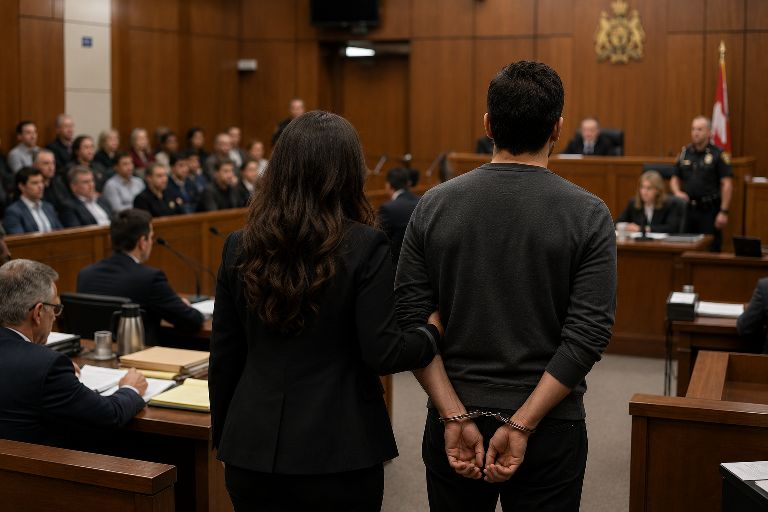
Domestic assault and domestic violence charges in Toronto
Short answer: A domestic assault charge is an assault, threat or other offence alleged against a current or former spouse, common-law partner or dating partner. Police in Ontario lay these charges whenever they have reasonable grounds, and only the Crown can withdraw them. The first problem is usually the release order, which often bars you from your home and from contact with your partner. Since 2026, violence against an intimate partner can also be charged under s. 263.1 of the Criminal Code, which raises the maximum sentence.
Civitas Law is a team of legal professionals under the leadership of lawyer Nasibeh Mehrpouyan, with an office at 4789 Yonge Street, Suite 402, Toronto, at Yonge and Sheppard in North York. We work in English, French, Farsi, Russian and Serbian. Our team acts for people accused of domestic assault and related offences in Toronto and across the GTA. If someone has just been arrested, start with our bail hearings page and call us, because the release conditions set in the first 24 hours shape everything that follows.
This page focuses on charges between intimate partners. Plain assault, assault with a weapon and assault causing bodily harm between strangers or acquaintances are covered on our assault lawyer page, and threats on their own are covered on our uttering threats page.
What counts as domestic assault in Ontario?
The Criminal Code defines an intimate partner as a current or former spouse, common-law partner or dating partner (s. 2). You do not need to have lived together. A short dating relationship that ended years ago still counts.
The charges most often laid in a domestic file are:
- Assault (s. 266), from a push or a grab to a slap. The force must be intentional and without consent.
- Assault with a weapon, causing bodily harm, or by choking, suffocating or strangling (s. 267).
- Uttering threats (s. 264.1), often laid for words said during the same argument.
- Criminal harassment (s. 264), for repeated contact or monitoring after a separation. See our criminal harassment page.
- Mischief (s. 430) for a broken phone or door, and forcible confinement (s. 279) where someone was kept from leaving.
- Failure to comply with a release order (s. 145) when contact happens after the first charge.
The 2026 intimate partner violence offence. In 2026 Parliament added s. 263.1. When an offence involving violence, or a threat or attempt of violence, is committed against an intimate partner, it can be charged under this section with a higher maximum. An included offence with a maximum of five years, such as assault or threatening death, carries up to 10 years under s. 263.1. One with a 10-year maximum, such as assault causing bodily harm, carries up to 14 years. The Crown can still proceed summarily where the included offence allows it.
Coercion or control. Parliament also enacted a separate offence of coercion or control of an intimate partner (s. 264.01) in 2026. It targets a pattern of controlling conduct such as monitoring, isolating or controlling finances that could make a partner fear for their safety. A new offence applies only to conduct after the day it comes into force, so ask us whether it applies to your dates.
What happens after a domestic assault arrest in Toronto
Most domestic files start with a 911 call. Officers separate the people, take statements, photograph any injuries, often record the complainant's account on video, and make an arrest if they have reasonable grounds. The complainant's wishes do not decide whether a charge is laid.
From there, one of two things happens:
- Release from the station on an undertaking with conditions, usually no contact with the complainant and no attendance at the home.
- A bail hearing, normally within 24 hours, at the Toronto Regional Bail Centre, 2201 Finch Avenue West. When the charge involves violence against an intimate partner, the justice must take that into account (s. 515(3)).
The onus shifts to the accused, a reverse onus, in two common domestic situations under s. 515(6): where an assault is alleged to have involved choking, suffocating or strangling, and where violence against an intimate partner is alleged and the accused has a prior conviction or discharge for intimate partner violence or was already on a peace bond made for an intimate partner. Our show cause hearing guide explains how these hearings work.
After release, the first appearance is usually at the Ontario Court of Justice in the Toronto Courthouse, 10 Armoury Street, where domestic cases are handled through Ontario's Domestic Violence Court program. The Crown provides disclosure, and the case moves through Crown and judicial pre-trials before any trial date is set.
No-contact conditions, the home and your children
The release order is often the hardest part of a domestic case. Typical conditions include:
- no contact or communication with the complainant, directly or through anyone else, including texts, social media and messages passed through friends or children;
- not attending the family home, the complainant's workplace or other listed places;
- no weapons, and surrender of any firearms licence;
- a surety or a residence condition elsewhere.
These conditions bind you, not the complainant. A partner who calls, visits or invites you home cannot cancel them, and contact in breach of the order is a separate criminal offence. See breach of bail conditions.
Conditions can change. Where the complainant wants contact and the Crown agrees after hearing from them, the order can be varied by consent. Otherwise a bail variation or a bail review in the Superior Court of Justice may be needed. Common first steps are contact through counsel, a police-escorted visit to collect belongings, and a third party for exchanges of the children.
If there are children, a family court case about parenting time, support or the home often runs alongside. What you say in one case can be used in the other, so the two need to be planned together with your family lawyer.
Can the complainant drop a domestic assault charge?
No. Once police lay the charge, it belongs to the Crown. A complainant who no longer wants the case to go ahead can tell the Crown or the Victim/Witness Assistance Program, and that view is considered, but the Crown decides whether there is a reasonable prospect of conviction and whether the case is in the public interest.
A complainant who does not want to testify can be served with a subpoena. If they testify differently from what they told police, the Crown may apply to use the earlier video statement as evidence. On the other side, a recanting complainant often affects how strong the Crown's case really is, and that is part of our review.
Please do not ask your partner to contact the Crown for you while a no-contact condition is in place. That contact can lead to new charges, including breach of release conditions and obstructing justice.
How domestic assault cases resolve in Toronto
Every case turns on its evidence, and no outcome can be promised. Depending on the facts and your history, the realistic paths include:
- Withdrawal by the Crown where the evidence does not support the charge.
- A peace bond under s. 810, where the charge is withdrawn and you agree to keep the peace and follow conditions for up to 12 months. A peace bond is not a conviction. Our peace bond page explains the details.
- The Partner Assault Response (PAR) program. Ontario's PAR program is 12 sessions of group education and counselling, delivered by community agencies, with a fee set according to income. In eligible first-time cases with no serious injury, completing PAR can be part of a resolution that ends in a peace bond or a discharge.
- A discharge under s. 730, conditional or absolute, which is a finding of guilt without a conviction.
- A trial, where the Crown must prove the case beyond a reasonable doubt and issues such as self-defence under s. 34, credibility and inconsistent statements are decided.
If there is a finding of guilt, abuse of an intimate partner is an aggravating factor on sentence (s. 718.2), and the court must endorse on the record that the offence involved intimate partner violence (s. 726.21). A weapons prohibition is mandatory where the Crown proceeded by indictment on an offence of violence against an intimate partner (s. 109), and in other cases the court must consider one, possibly for life (s. 110).
What does a domestic assault lawyer cost in Toronto?
Criminal defence fees depend on the charge, the volume of disclosure, whether there is a bail hearing, how many court appearances are needed and whether the case goes to trial. Too few Toronto firms publish a fee for this type of charge to give a reliable market figure, so we do not show one. For context, the ranges Ontario firms do publish for other charges are below.
| Service | Typical fee | Range published |
|---|---|---|
| Impaired driving or over 80, first offence, resolved without trial | $5,900 | $3,500 to $15,000 |
| Simple assault, mischief or theft under $5,000 | $5,750 | $1,500 to $15,000 |
| Hourly rate, criminal defence | about $410 an hour | $75 to $800 an hour |
How we measured this: we reviewed fee ranges that Ontario criminal defence firms publish on their own websites, checked in November 2026. These are typical market ranges, not Civitas Law's fees, and they usually exclude HST and disbursements. Only a few firms publish criminal fees, so a figure is shown only where at least three firms published one. Civitas Law explains its fee in writing before you retain us. The 30-minute consultation is $150 plus HST, paid when you book.
Immigration, travel and your record after a domestic charge
Immigration. Tell us at the first meeting if you are not a Canadian citizen. Under s. 36 of the Immigration and Refugee Protection Act, a permanent resident is inadmissible for serious criminality after a conviction for an offence with a maximum of at least 10 years, or where a sentence of more than six months is imposed. Because s. 263.1 raises the maximum for many domestic offences to 10 years or more, a domestic conviction can now reach that threshold even where the underlying offence would not. Hybrid offences count as indictable for immigration purposes even when prosecuted summarily. A discharge or a peace bond is not a conviction. See immigration consequences of criminal charges and our immigration page.
Travel. A pending charge or a record can lead to questions or refusal at the United States border. If you must travel while the case is open, check your release conditions first.
Your record. A conviction stays on your record until a record suspension is granted. A discharge is not a conviction, and its record is removed from the national police database after one year for an absolute discharge and three years for a conditional discharge, as long as there is no new offence.
What our team reviews in a domestic assault case
- The 911 call, police notes, body-worn camera video and the complainant's recorded statement.
- Photos and medical records, and whether any injury matches the account given.
- Text messages, emails and social media between you and the complainant, before and after the incident, read in full rather than in the excerpts police selected.
- Whether you were defending yourself or someone else under s. 34.
- For clients who speak Farsi, Russian, Serbian or French, how statements were translated or interpreted.
- Any family court filings, because allegations sometimes surface first in a parenting dispute.
- Your release conditions, your housing and your contact with your children.
- Immigration, employment and licensing consequences of every possible outcome.
In the first days: keep a copy of your release paper, follow every condition exactly, do not post about the case online, write down your own timeline while it is fresh, and save every message rather than deleting it. Then Book a consultation (30 minutes, $150 plus HST, paid when you book) or call (647) 271-1646.
Questions we hear often
General information, not legal advice. Every matter is different.
What is a domestic assault charge in Ontario?
Is domestic assault a criminal charge in Canada?
Can a domestic assault charge be dropped in Ontario?
What happens with a first-time domestic assault charge in Ontario?
What is the jail time for domestic assault in Canada?
What happens if I am charged with domestic assault a second time?
How can a domestic assault charge be resolved without a trial?
Can I go home after a domestic assault charge?
Can I change a no-contact bail condition in a domestic assault case?
Can my partner cancel the no-contact order?
What is the Partner Assault Response program?
Is a peace bond a criminal record?
Will a domestic assault charge affect custody or parenting time?
Can a permanent resident be deported for domestic assault?
Can a domestic assault charge be removed from my record?
What if I was defending myself?
Can I get a firearms licence after a domestic assault charge?
What happens at the first court appearance for domestic assault in Toronto?
How long does a domestic assault case take in Toronto?
What is coercive control in Canada?
Do I need a lawyer for a domestic assault charge?
Do you act for domestic assault clients in North York and across the GTA?
Related services and guides
Criminal defence
All criminal charges in Toronto courts.
Assault charges
Assault, assault with a weapon and bodily harm.
Peace bonds
Section 810 peace bonds and how they resolve charges.
Uttering threats
Threats in person, by text or online.
Bail variation
Changing no-contact and residence conditions.
Family law
Parenting, support and the family home.
Talk to our team
Book a consultation online or call (647) 271-1646 (the phone is answered 24/7). 30-minute consultation, $150 plus HST, paid when you book. Legal fees after that depend on the work involved, and we explain them in writing before you retain us.
Straightforward legal advice from a Toronto lawyer.
30-minute consultation, $150 plus HST, paid when you book. Personal injury matters start with a free 10-minute case review with the lawyer. Consultations are confidential.