Commissioner of Oaths in Toronto: Affidavits and Statutory Declarations
A commissioner of oaths administers the oath or declaration on an affidavit or statutory declaration and signs the jurat. This page explains who can commission documents in Ontario, how a sworn affidavit and a statutory declaration differ, what to bring, remote commissioning rules and how Civitas Law commissions documents in Toronto.
30-minute consultation, $150 plus HST, paid when you book.
What a commissioner of oaths does in Ontario
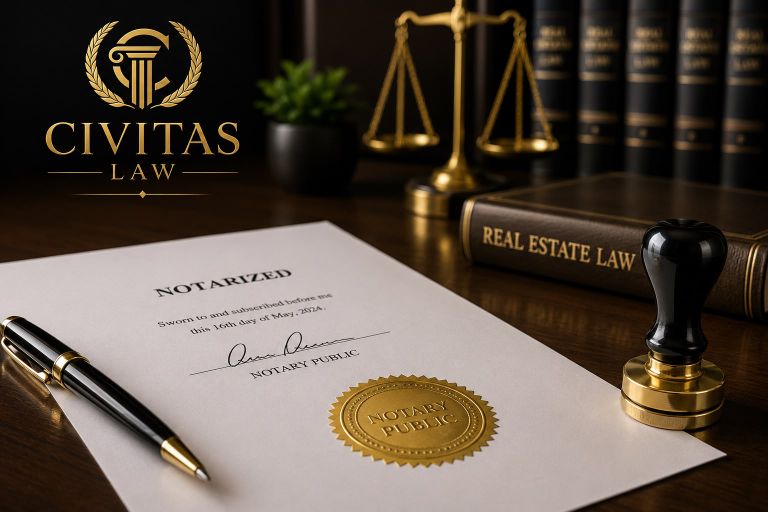
Short answer: A commissioner for taking affidavits, usually called a commissioner of oaths, administers the oath, affirmation or declaration on an affidavit or statutory declaration and signs the jurat that records where and when it was sworn. Every Ontario lawyer and licensed paralegal is a commissioner by virtue of their licence. You sign the document in front of the commissioner, with photo ID, after swearing or affirming that its contents are true.
Civitas Law is a team of legal professionals under the leadership of lawyer Nasibeh Mehrpouyan, a lawyer who is both a commissioner for taking affidavits and a notary public. We commission affidavits and statutory declarations for Ontario courts, tribunals, government offices, banks, insurers and immigration applications, in English, French, Farsi, Russian and Serbian, at 4789 Yonge Street, Suite 402, at Yonge and Sheppard in North York.
The commissioner's job is limited and important. The commissioner confirms who you are, makes sure you understand what you are signing, administers the oath or declaration in a way that binds your conscience, and signs the jurat. The commissioner does not confirm that what you say is true; you do, under oath, and the law treats a false statement seriously.
If your document is going to another country or the office asks for a notarized document or a certified copy, you need a notary public rather than a commissioner. Our notary public page explains the difference, and our certified true copy page covers copies.
Who can be a commissioner of oaths in Ontario?
Ontario's Commissioners for Taking Affidavits Act and its regulation create two groups:
- Commissioners by virtue of office. Lawyers and licensed paralegals are commissioners because of their licence. As of November 2026 the regulation also lists judges, justices of the peace, members of the provincial legislature and their constituency staff for constituent work, municipal clerks, ServiceOntario staff while serving the public, and police officers only as part of their duties.
- Appointed commissioners. Other people can be appointed by the province, usually for their employer's purposes, with limits shown on an approved stamp. Appointments made on or after January 1, 2026 run for 10 years and can be renewed.
Notaries public can do everything a commissioner can do. Commissioners cannot take their own affidavits, must not give legal advice unless they are lawyers or paralegals, and an appointed commissioner cannot act after the expiry date on their stamp. Whether a particular government office will commission your type of document is up to that office.
Affidavit or statutory declaration: what is the difference?
Both are written statements of fact that you confirm before a commissioner. The difference is mostly about where they are used and the words of confirmation.
- An affidavit is sworn or affirmed, usually as evidence in a court or tribunal proceeding. In Ontario civil cases, rule 4.06 of the Rules of Civil Procedure sets the format, including exhibits, alterations and affidavits sworn through an interpreter. The Family Law Rules have their own affidavit forms.
- A statutory declaration is a solemn declaration, usually for a government office, bank, insurer or other organization outside of a lawsuit. The declarant states that they make it "conscientiously believing it to be true" and knowing it has the same force and effect as if made under oath. Ontario's Evidence Act covers declarations under Ontario law, and section 41 of the federal Canada Evidence Act covers federal ones.
Common statutory declarations include declarations of common-law union and marital status for immigration, lost document and identity declarations, declarations for insurance claims and estate matters, and declarations of facts for banks and registries. If an office gives you its own form, use that form and do not change its wording.
Swearing an oath or making a solemn affirmation
Under Ontario's Evidence Act, an oath or affirmation must be one the person declares binding on their conscience. You can swear on a religious text of your choice, swear without one, or make a solemn affirmation with no religious content. All carry the same legal weight, and you should never be pressured to choose one over another. You can bring your own religious text if you prefer.
The commissioner asks you to confirm that the contents of the document are true, and you answer aloud. Many commissioners then ask whether you consider yourself bound by the oath or affirmation. Only after that does the commissioner sign the jurat. If you do not understand the language of the document, the jurat must show that it was interpreted by a sworn interpreter, so tell us in advance if you need one. Our team can explain documents in English, French, Farsi, Russian and Serbian.
What goes at the end of an affidavit
The jurat is the block at the end of the affidavit or declaration that records the swearing. For an in-person affidavit it states the city or town, the county or regional municipality, the date, and "Sworn (or affirmed) before me", followed by the commissioner's signature and stamp or printed name and title. For a declaration it reads "Declared before me". Exhibits referred to in the affidavit are marked by the commissioner, and any handwritten change must be initialled by the commissioner, or the affidavit may not be usable without a judge's permission.
A commissioner who signs a jurat without being satisfied the signature is genuine, or without administering the oath as the law requires, commits a provincial offence with a fine of up to $2,000. Signing a document as sworn when it was not is also an offence under section 138 of the Criminal Code.
What does a commissioner of oaths cost in Toronto?
| Service | Typical fee | Range published |
|---|---|---|
| Affidavit or statutory declaration, drafted and commissioned | $120 | $100 to $125 |
| Drafting an affidavit only (commissioning extra) | from $53 | $41 to $95 |
| Notarizing one signature or document | $30 | $17 to $120 |
| Each additional signature or document, same visit | $22 | $15 to $80 |
| Mobile visit surcharge (on top of the notary fee) | $60 | $55 to $150 |
How we measured this: we reviewed the fees that 15 notary offices and law firms in Toronto and the GTA publish on their own websites, checked in November 2026. Figures are before HST unless stated. These are typical market fees, not Civitas Law's fees. Civitas Law tells you its fee in writing before any work starts, and any government fee is paid on top of the notary fee.
How Civitas Law can help
Affidavits and statutory declarations can also be commissioned by live video where Ontario's remote commissioning rules allow it, so you do not always need to come to the office. Mobile appointments at a home, hospital or office in Toronto can be arranged for an additional fee, which we confirm in writing before the visit.
Remote commissioning in Ontario
The general rule in section 9 of the Commissioners for Taking Affidavits Act is that the person swearing must be in the commissioner's physical presence. Ontario Regulation 431/20, as amended, allows an oath or declaration to be taken remotely when its conditions are met. Under the province's guidance as of November 2026, those include:
- a live connection where everyone can see, hear and communicate in real time throughout;
- the commissioner confirming the person's identity and taking reasonable precautions, including making sure the person understands what they are signing;
- a modified jurat stating that the oath was administered under the regulation and the location of the commissioner and of the person swearing;
- a record of the transaction kept by the commissioner.
Nothing requires an office to accept a remotely commissioned document, so confirm with the court, tribunal or organization before choosing this route. Documents going outside Canada are a separate matter: Ontario authenticates only paper documents that were notarized, never documents that were only commissioned. See our apostille page.
What to bring to have an affidavit commissioned
- The document, unsigned. You sign it in front of the commissioner.
- Valid government photo identification for each person swearing.
- All exhibits referred to in the affidavit, in order, so each can be marked.
- The receiving office's form or instructions, if it supplied one.
- An interpreter, if you will swear an affidavit in a language you do not read, unless our team speaks it.
Read the whole document before the appointment. If anything is wrong, it is easier to correct it in a fresh draft than by hand at the appointment. If you are not sure what the affidavit should say, that is a legal question: book a 30-minute consultation for $150 plus HST, paid when booking, and we can review it with you.
Why the truth of an affidavit matters
Making a false statement in an affidavit or solemn declaration, knowing it is false and intending to mislead, is perjury under section 131 of the Criminal Code, with a maximum of 14 years' imprisonment under section 132. Section 134 makes a knowingly false sworn statement an offence even where the statement was not required by law. Beyond criminal law, a false affidavit can destroy your credibility in a court case or lead to an immigration application being refused for misrepresentation.
Write only what you know personally, say so when information comes from someone else, and do not overstate. Related pages: declarations for immigration, travel consent letters and powers of attorney. To book, call (647) 271-1646 or use our booking page.
Questions we hear often
General information, not legal advice. Every matter is different.
Who can be a commissioner of oaths in Ontario?
Does ServiceOntario provide a commissioner of oaths?
Where can I find a commissioner of oaths in Toronto at no charge?
How do I get an affidavit in Ontario?
Where can I go to do an affidavit in Toronto?
Who can make an affidavit in Canada?
What is required for an affidavit to be valid in Ontario?
What should you not say in an affidavit?
What documents are needed for an affidavit?
What do you write at the end of an affidavit?
Can I swear my own affidavit?
Can you commission an affidavit online in Ontario?
How much does it cost to get an affidavit done in Toronto?
What is a statutory declaration in Ontario?
What is a sworn affidavit?
Do I need a statutory declaration for a PR card or visitor visa?
What is the most common mistake when commissioning a document?
What is the difference between swearing and affirming?
Related services and guides
Notary public services
Notarization, commissioning and certified copies in Toronto.
Immigration documents
Statutory declarations and invitation letters for IRCC.
Certified true copies
Notarized copies of passports, degrees and records.
Apostille in Toronto
Notarized documents for use outside Canada.
Talk to our team
Book a consultation online or call (647) 271-1646 (the phone is answered Monday to Friday, 9 am to 8 pm, and Saturday, 10 am to 6 pm). 30-minute consultation, $150 plus HST, paid when you book. Legal fees after that depend on the work involved, and we explain them in writing before you retain us.
Straightforward legal advice from a Toronto lawyer.
30-minute consultation, $150 plus HST, paid when you book. Personal injury matters start with a free 10-minute case review with the lawyer. Consultations are confidential.